6 Best Heidi Health Alternatives & Competitors
Heidi Health entered the AI scribe market from Australia with a compelling proposition: a free tier, 110+ language support, and over 200 note templates. For many clinicians — particularly those in international or multilingual settings — it was a reasonable starting point. But as the platform has scaled and pricing has shifted, a growing number of physicians are actively researching a Heidi Health alternative that better fits their clinical workflow, budget, or reliability requirements.
This guide is written for clinicians who are either currently using Heidi and running into limitations, or evaluating it alongside other best AI scribes for the first time. We will cover specific features, real pricing, EHR integration depth, and the practical trade-offs of each option.
Why clinicians look for Heidi Health alternatives
Before evaluating alternatives, it is worth understanding the specific friction points that drive clinicians away from Heidi Health. These are not theoretical — they reflect patterns reported across user forums, Trustpilot reviews, and clinician communities through mid-2026.
Feature gating and enterprise lock-in
Heidi's Clinician plan is priced at $150/month (up from approximately $90 in prior years). At that price point, two features many clinicians consider essential — EHR push-to-chart and billing code suggestions — remain unavailable. Both are gated behind an Enterprise tier with unpublished pricing.
For a solo practitioner or small group practice, this creates a difficult calculus: you are paying a premium monthly rate but still lack the integrations that would actually save you chart-closing time. A detailed Freed vs Heidi comparison breaks this down further.
Reliability and note quality concerns
Heidi Health's Trustpilot rating has declined to 3.3 out of 5 as of July 2026, with recurring complaints about two specific issues:
- Lost recordings: Users report 3–6 lost recordings per week, which in a clinical context means re-documenting encounters from memory or losing billable detail entirely.
- Medication hallucinations: Instances where the AI inserts medications not discussed during the visit. In specialties like psychiatry or pain management, this is not a minor inconvenience — it is a patient safety concern.
Additionally, Heidi does not offer persistent style learning. Each session starts fresh; the system does not adapt to your preferred note structure, terminology, or documentation patterns over time — a gap that shows up most in clinical documentation for complex, multi-problem encounters.
What to evaluate in an AI scribe
When considering any Heidi Health alternative, focus your evaluation on the criteria that directly affect your daily workflow and medical documentation quality:
- EHR integration depth — Can the tool push notes directly into your chart, or does it require copy-paste? Is this available on your plan tier, or locked behind enterprise pricing?
- Coding support — Does the tool suggest ICD-10 and CPT codes from the encounter? Is this included or an add-on?
- Note personalization — Does the system learn your preferred note style, or do you re-configure templates every session?
- Pricing transparency — Is the published price the actual price, or are essential features gated?
- Reliability at scale — How does the tool perform across a full clinic day of 20+ encounters?
- Support model — When something breaks mid-clinic, can you reach a human?
Top Heidi Health alternatives compared
1. Freed — transparent pricing, full-feature access
Pricing
$59–$119/month, depending on plan (lower with annual billing)
Overview
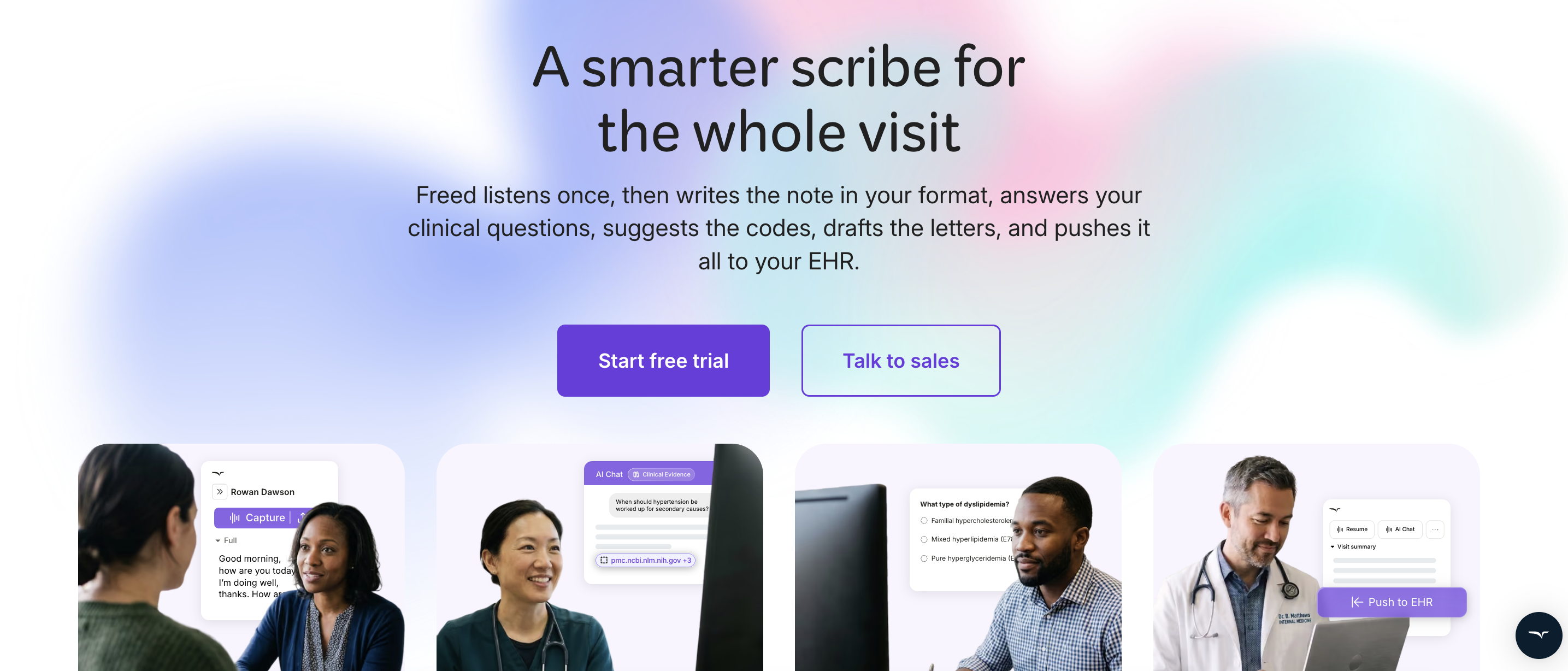
Freed is purpose-built for the US clinical market and takes a fundamentally different approach to feature access: ICD-10/CPT coding, EHR integration with 50+ systems, and one-click push-to-chart are included on Freed's Premier plan — published pricing, not an enterprise negotiation. (Freed's EHR integrations do not currently include Epic.)
The distinguishing technical feature is Learn Format, a persistent note personalization engine. Freed observes your edits and adapts its output to match your documentation style over time. For clinicians who handle complex, multi-problem encounters — internal medicine, family practice, psychiatry — this meaningfully reduces post-visit editing.
Freed also provides dedicated human support, which matters when a technical issue arises during a packed clinic schedule.
2. Suki AI — voice-first, deep EHR integration

Pricing
~$399/month
Overview
Suki is built around voice interaction and offers among the deepest native EHR integrations in the market, including bi-directional data exchange with Epic and Cerner. For health systems that have already committed to a specific EHR ecosystem, Suki can embed directly into existing charting workflows.
The trade-off is price. At $399/month, Suki is positioned as a premium tool and is most cost-effective for high-volume specialists or organizations with enterprise contracts. The cost of AI scribes varies substantially, and Suki sits at the higher end. If Suki's pricing is the sticking point, our Suki AI alternatives roundup covers more budget-friendly options.
3. Nabla Copilot — free tier with European compliance

Pricing
Free tier available | Paid plans vary
Overview
Nabla is a strong option for clinicians practicing in the EU or handling cross-border patient data. It is built with GDPR compliance as a foundational design constraint, not a retrofit. The free tier is functional for basic ambient documentation.
For US-based clinicians, Nabla's EHR integration options are more limited than domestic-focused competitors, and its specialty template library is narrower. But for multilingual practices or those with European regulatory obligations, it fills a specific niche.
4. DeepScribe — specialty-tuned for complex care
Pricing
$350–$750/month (enterprise contracts only)
Overview
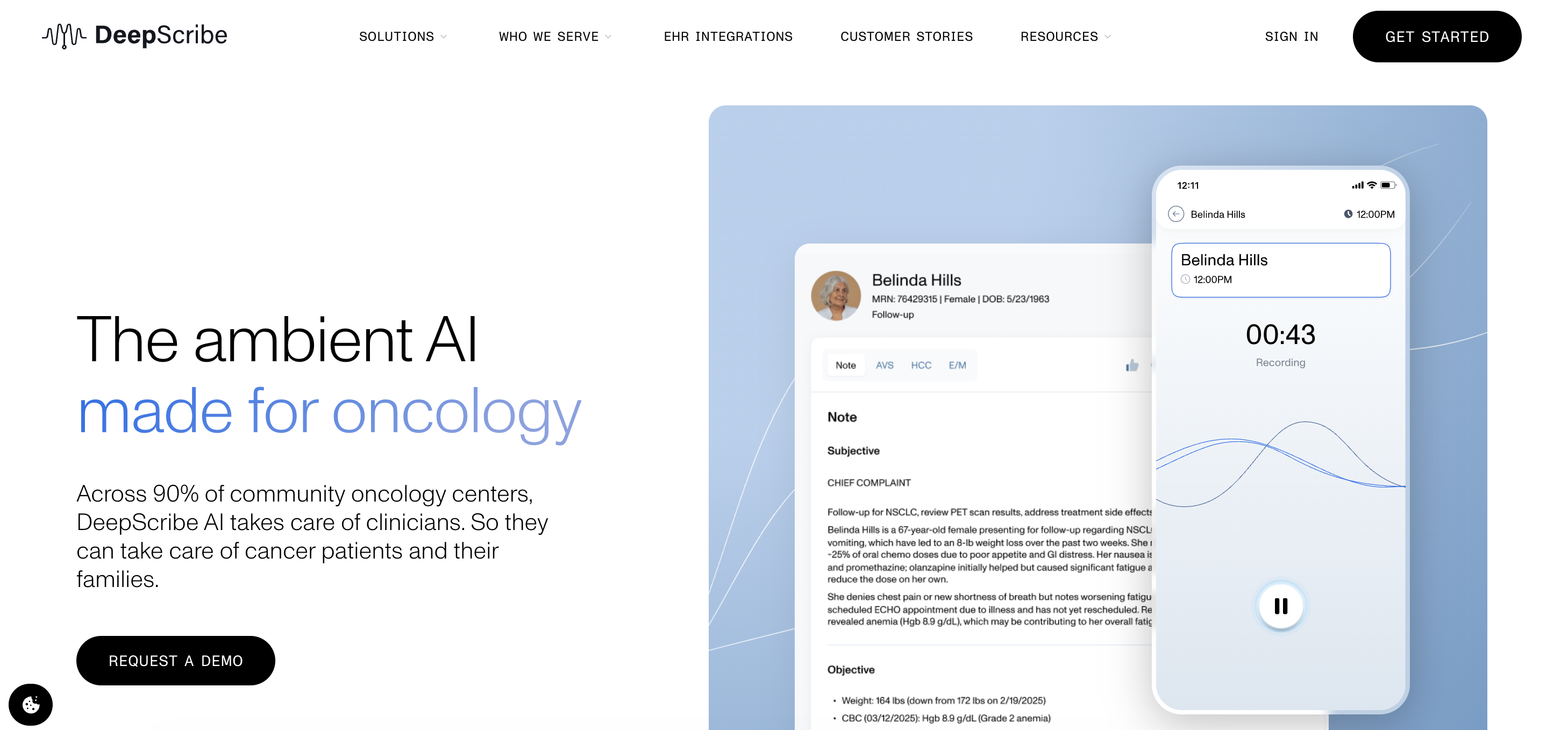
DeepScribe has invested heavily in specialty-specific AI models, particularly in oncology and complex procedural documentation. The documentation quality for tumor board notes and multi-drug regimen encounters is notably strong.
The limitation is accessibility: DeepScribe is enterprise-only, with no self-serve sign-up or monthly plan for individual clinicians. Pricing ranges from $350–$750/month depending on contract terms and volume. See our full DeepScribe alternatives guide for more self-serve options.
5. Dragon Copilot — enterprise Epic ecosystem
Pricing
Enterprise contracts (unpublished)
Overview
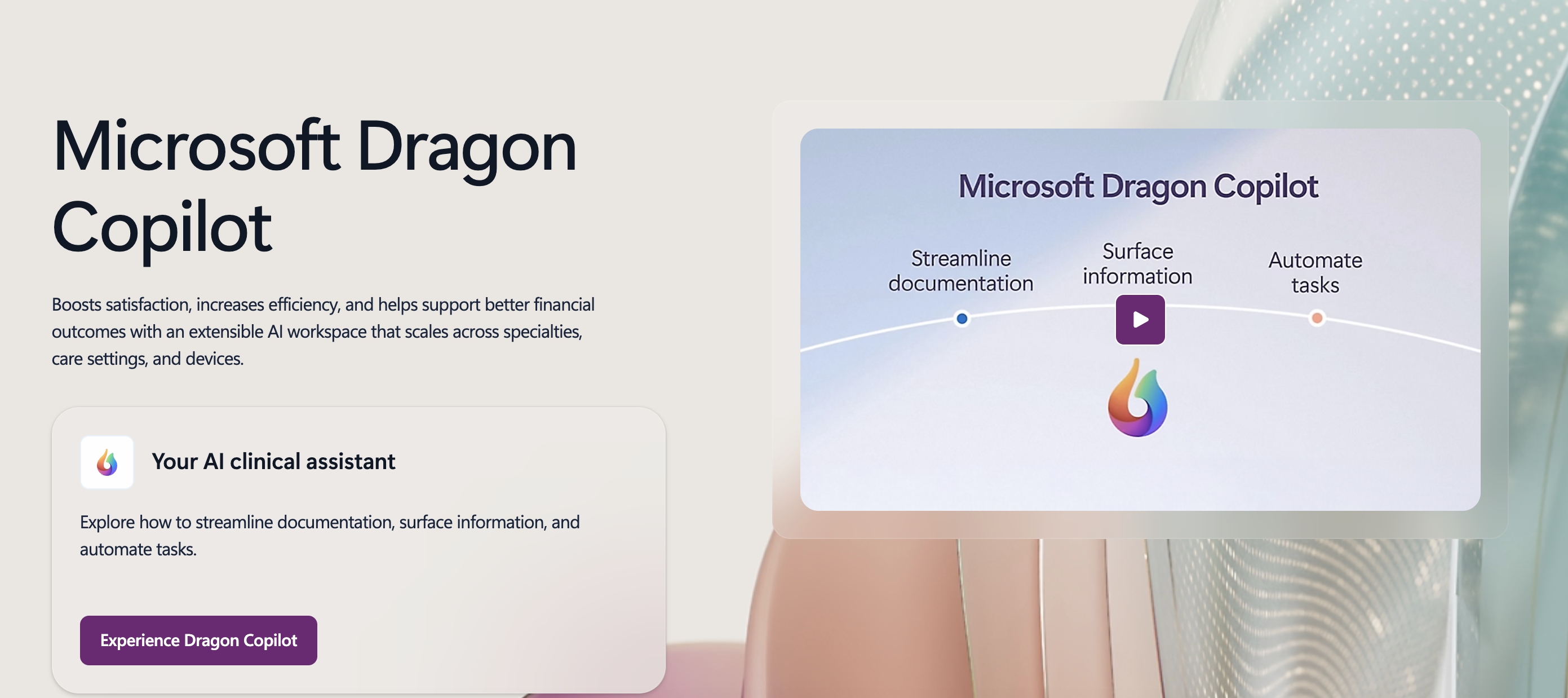
Dragon Copilot (formerly Nuance DAX), backed by Microsoft, is the ambient documentation layer within the broader Nuance/Epic ecosystem. For large health systems already running Epic and Dragon Medical, Dragon Copilot offers a tightly integrated, IT-approved option.
For independent practices or small groups, Dragon Copilot is effectively inaccessible — it requires enterprise procurement, IT infrastructure, and a Microsoft ecosystem commitment.
6. Doximity Scribe — free for verified US physicians
Pricing
Free (included with Doximity membership)
Overview
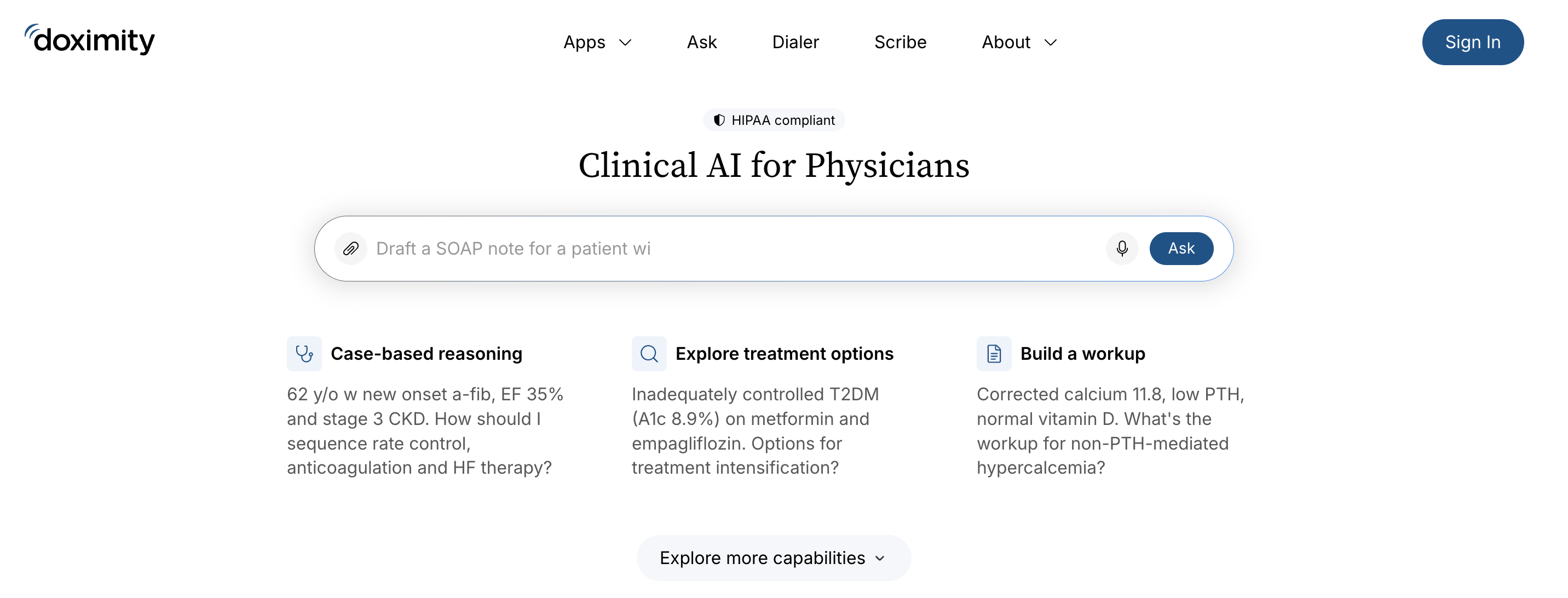
Doximity offers its AI scribe at no additional cost to verified US physicians. For clinicians who want to experiment with AI documentation without any financial commitment, it is the lowest-friction entry point.
The feature set is intentionally limited: no EHR integration, no coding suggestions, and no persistent note customization. It functions well as a drafting assistant but does not replace a full-featured virtual medical scribe workflow.
Side-by-side feature comparison
| Heidi Health alternatives: at a glance | |||||||
|---|---|---|---|---|---|---|---|
| Feature | Heidi Health | Freed | Suki AI | Nabla | DeepScribe | Dragon Copilot | Doximity |
| Monthly price | $150 (Clinician) | $59–$119 | ~$399 | Free tier available | $350–$750 | Enterprise | Free |
| Free tier | Yes (limited) | No | No | Yes | No | No | Yes |
| EHR push-to-chart | Enterprise only | Premier plan (50+ EHRs, not Epic) | Yes (deep) | Limited | Yes | Epic-native | No |
| ICD-10/CPT codes | Enterprise only | Premier plan | Yes | Limited | Yes | Yes | No |
| Note personalization | Templates only | Persistent Learn Format | Moderate | Basic | Specialty models | Moderate | Basic |
| Language support | 110+ languages | English-focused | English | Multi-language + GDPR | English | English | English |
| Trustpilot / satisfaction | 3.3/5 (July 2026) | 4.9/5 | N/A | N/A | N/A | N/A | N/A |
| Support model | Ticketed | Dedicated human | Account manager | Ticketed | Account manager | Enterprise IT | Community |
| Best for | Multilingual / international | US solo & group practice | High-volume EHR-heavy | EU / GDPR settings | Oncology / specialty | Epic health systems | Low-risk trial |
How to choose the right alternative
Choosing a Heidi Health alternative is not about finding the "best" tool in the abstract — it is about matching the tool to your specific practice context:
- Solo or small group, US-based, need coding + EHR on day one: Freed offers a complete feature set at a transparent, published price point. What Heidi gates behind Enterprise, Freed includes on its Premier plan — no negotiation required.
- Large health system on Epic: Dragon Copilot is the path of least IT resistance, assuming your organization has the procurement infrastructure.
- High-volume specialist wanting voice-native workflow: Suki's depth of EHR integration and voice-first design may justify the premium.
- EU-based or GDPR-constrained practice: Nabla is the only option built with European data residency from the ground up.
- Want to try AI scribing with zero commitment: Doximity Scribe or Heidi's own free tier are both viable starting points, understanding the feature limitations.
For most US-based clinicians who want reliable ambient documentation with full coding and EHR integration without enterprise negotiations, Freed addresses the specific gaps that make clinicians search for a Heidi Health alternative in the first place. Try Freed free for 10 encounters and compare the note quality against your current workflow.
Comparing other AI scribes?
Heidi isn't the only scribe worth sizing up against Freed. If you're evaluating more broadly, take a look at our breakdowns of Abridge alternatives and Twofold alternatives, or see how Freed stacks up head-to-head against Twofold.
Ready to compare for yourself? Start a free trial of Freed — no credit card required — and run it alongside your current tool for a week. The note quality speaks for itself.

Table of Contents
Heidi Health entered the AI scribe market from Australia with a compelling proposition: a free tier, 110+ language support, and over 200 note templates. For many clinicians — particularly those in international or multilingual settings — it was a reasonable starting point. But as the platform has scaled and pricing has shifted, a growing number of physicians are actively researching a Heidi Health alternative that better fits their clinical workflow, budget, or reliability requirements.
This guide is written for clinicians who are either currently using Heidi and running into limitations, or evaluating it alongside other best AI scribes for the first time. We will cover specific features, real pricing, EHR integration depth, and the practical trade-offs of each option.
Why clinicians look for Heidi Health alternatives
Before evaluating alternatives, it is worth understanding the specific friction points that drive clinicians away from Heidi Health. These are not theoretical — they reflect patterns reported across user forums, Trustpilot reviews, and clinician communities through mid-2026.
Feature gating and enterprise lock-in
Heidi's Clinician plan is priced at $150/month (up from approximately $90 in prior years). At that price point, two features many clinicians consider essential — EHR push-to-chart and billing code suggestions — remain unavailable. Both are gated behind an Enterprise tier with unpublished pricing.
For a solo practitioner or small group practice, this creates a difficult calculus: you are paying a premium monthly rate but still lack the integrations that would actually save you chart-closing time. A detailed Freed vs Heidi comparison breaks this down further.
Reliability and note quality concerns
Heidi Health's Trustpilot rating has declined to 3.3 out of 5 as of July 2026, with recurring complaints about two specific issues:
- Lost recordings: Users report 3–6 lost recordings per week, which in a clinical context means re-documenting encounters from memory or losing billable detail entirely.
- Medication hallucinations: Instances where the AI inserts medications not discussed during the visit. In specialties like psychiatry or pain management, this is not a minor inconvenience — it is a patient safety concern.
Additionally, Heidi does not offer persistent style learning. Each session starts fresh; the system does not adapt to your preferred note structure, terminology, or documentation patterns over time — a gap that shows up most in clinical documentation for complex, multi-problem encounters.
What to evaluate in an AI scribe
When considering any Heidi Health alternative, focus your evaluation on the criteria that directly affect your daily workflow and medical documentation quality:
- EHR integration depth — Can the tool push notes directly into your chart, or does it require copy-paste? Is this available on your plan tier, or locked behind enterprise pricing?
- Coding support — Does the tool suggest ICD-10 and CPT codes from the encounter? Is this included or an add-on?
- Note personalization — Does the system learn your preferred note style, or do you re-configure templates every session?
- Pricing transparency — Is the published price the actual price, or are essential features gated?
- Reliability at scale — How does the tool perform across a full clinic day of 20+ encounters?
- Support model — When something breaks mid-clinic, can you reach a human?
Top Heidi Health alternatives compared
1. Freed — transparent pricing, full-feature access
Pricing
$59–$119/month, depending on plan (lower with annual billing)
Overview
Freed is purpose-built for the US clinical market and takes a fundamentally different approach to feature access: ICD-10/CPT coding, EHR integration with 50+ systems, and one-click push-to-chart are included on Freed's Premier plan — published pricing, not an enterprise negotiation. (Freed's EHR integrations do not currently include Epic.)
The distinguishing technical feature is Learn Format, a persistent note personalization engine. Freed observes your edits and adapts its output to match your documentation style over time. For clinicians who handle complex, multi-problem encounters — internal medicine, family practice, psychiatry — this meaningfully reduces post-visit editing.
Freed also provides dedicated human support, which matters when a technical issue arises during a packed clinic schedule.
2. Suki AI — voice-first, deep EHR integration
Pricing
~$399/month
Overview
Suki is built around voice interaction and offers among the deepest native EHR integrations in the market, including bi-directional data exchange with Epic and Cerner. For health systems that have already committed to a specific EHR ecosystem, Suki can embed directly into existing charting workflows.
The trade-off is price. At $399/month, Suki is positioned as a premium tool and is most cost-effective for high-volume specialists or organizations with enterprise contracts. The cost of AI scribes varies substantially, and Suki sits at the higher end. If Suki's pricing is the sticking point, our Suki AI alternatives roundup covers more budget-friendly options.
3. Nabla Copilot — free tier with European compliance
Pricing
Free tier available | Paid plans vary
Overview
Nabla is a strong option for clinicians practicing in the EU or handling cross-border patient data. It is built with GDPR compliance as a foundational design constraint, not a retrofit. The free tier is functional for basic ambient documentation.
For US-based clinicians, Nabla's EHR integration options are more limited than domestic-focused competitors, and its specialty template library is narrower. But for multilingual practices or those with European regulatory obligations, it fills a specific niche.
4. DeepScribe — specialty-tuned for complex care
Pricing
$350–$750/month (enterprise contracts only)
Overview
DeepScribe has invested heavily in specialty-specific AI models, particularly in oncology and complex procedural documentation. The documentation quality for tumor board notes and multi-drug regimen encounters is notably strong.
The limitation is accessibility: DeepScribe is enterprise-only, with no self-serve sign-up or monthly plan for individual clinicians. Pricing ranges from $350–$750/month depending on contract terms and volume. See our full DeepScribe alternatives guide for more self-serve options.
5. Dragon Copilot — enterprise Epic ecosystem
Pricing
Enterprise contracts (unpublished)
Overview
Dragon Copilot (formerly Nuance DAX), backed by Microsoft, is the ambient documentation layer within the broader Nuance/Epic ecosystem. For large health systems already running Epic and Dragon Medical, Dragon Copilot offers a tightly integrated, IT-approved option.
For independent practices or small groups, Dragon Copilot is effectively inaccessible — it requires enterprise procurement, IT infrastructure, and a Microsoft ecosystem commitment.
6. Doximity Scribe — free for verified US physicians
Pricing
Free (included with Doximity membership)
Overview
Doximity offers its AI scribe at no additional cost to verified US physicians. For clinicians who want to experiment with AI documentation without any financial commitment, it is the lowest-friction entry point.
The feature set is intentionally limited: no EHR integration, no coding suggestions, and no persistent note customization. It functions well as a drafting assistant but does not replace a full-featured virtual medical scribe workflow.
Side-by-side feature comparison
| Heidi Health alternatives: at a glance | |||||||
|---|---|---|---|---|---|---|---|
| Feature | Heidi Health | Freed | Suki AI | Nabla | DeepScribe | Dragon Copilot | Doximity |
| Monthly price | $150 (Clinician) | $59–$119 | ~$399 | Free tier available | $350–$750 | Enterprise | Free |
| Free tier | Yes (limited) | No | No | Yes | No | No | Yes |
| EHR push-to-chart | Enterprise only | Premier plan (50+ EHRs, not Epic) | Yes (deep) | Limited | Yes | Epic-native | No |
| ICD-10/CPT codes | Enterprise only | Premier plan | Yes | Limited | Yes | Yes | No |
| Note personalization | Templates only | Persistent Learn Format | Moderate | Basic | Specialty models | Moderate | Basic |
| Language support | 110+ languages | English-focused | English | Multi-language + GDPR | English | English | English |
| Trustpilot / satisfaction | 3.3/5 (July 2026) | 4.9/5 | N/A | N/A | N/A | N/A | N/A |
| Support model | Ticketed | Dedicated human | Account manager | Ticketed | Account manager | Enterprise IT | Community |
| Best for | Multilingual / international | US solo & group practice | High-volume EHR-heavy | EU / GDPR settings | Oncology / specialty | Epic health systems | Low-risk trial |
How to choose the right alternative
Choosing a Heidi Health alternative is not about finding the "best" tool in the abstract — it is about matching the tool to your specific practice context:
- Solo or small group, US-based, need coding + EHR on day one: Freed offers a complete feature set at a transparent, published price point. What Heidi gates behind Enterprise, Freed includes on its Premier plan — no negotiation required.
- Large health system on Epic: Dragon Copilot is the path of least IT resistance, assuming your organization has the procurement infrastructure.
- High-volume specialist wanting voice-native workflow: Suki's depth of EHR integration and voice-first design may justify the premium.
- EU-based or GDPR-constrained practice: Nabla is the only option built with European data residency from the ground up.
- Want to try AI scribing with zero commitment: Doximity Scribe or Heidi's own free tier are both viable starting points, understanding the feature limitations.
For most US-based clinicians who want reliable ambient documentation with full coding and EHR integration without enterprise negotiations, Freed addresses the specific gaps that make clinicians search for a Heidi Health alternative in the first place. Try Freed free for 10 encounters and compare the note quality against your current workflow.
Comparing other AI scribes?
Heidi isn't the only scribe worth sizing up against Freed. If you're evaluating more broadly, take a look at our breakdowns of Abridge alternatives and Twofold alternatives, or see how Freed stacks up head-to-head against Twofold.
Ready to compare for yourself? Start a free trial of Freed — no credit card required — and run it alongside your current tool for a week. The note quality speaks for itself.
FAQs
Frequently asked questions from clinicians and medical practitioners.

Is Heidi Health free?

What is the best Heidi Health alternative for solo practitioners?
Does Heidi Health integrate with Epic and other EHRs?
How accurate is Heidi Health for medical documentation?
Can I switch from Heidi Health to another AI scribe easily?

Related content
Free yourself for better things


548 Market Street, PMB 95301
San Francisco, CA 94104
Specialties
Compliance & Security
Our technology is HIPAA-compliant, uses industry best practices, and doesn’t store patient recordings.