Patient Information Sheet: Example & Downloadable Template
Paperwork shouldn’t slow down patient care. A well-structured patient information sheet helps your team collect the right details upfront—without the back-and-forth.
This easy-to-use, downloadable template organizes key patient information, from demographics and insurance coverage to emergency contacts and medical history. With clear, standardized sections, it helps your team:
- Prevent billing errors by verifying insurance details early.
- Improve emergency response with up-to-date contact information.
- Ensure continuity of care by tracking past treatments, medications, and allergies.
Because better records mean better care — and less time spent on admin.
Download our free patient information sheet
Download the digital form to use online or print in practice.
Here's a breakdown of what you'll find in our patient information form.
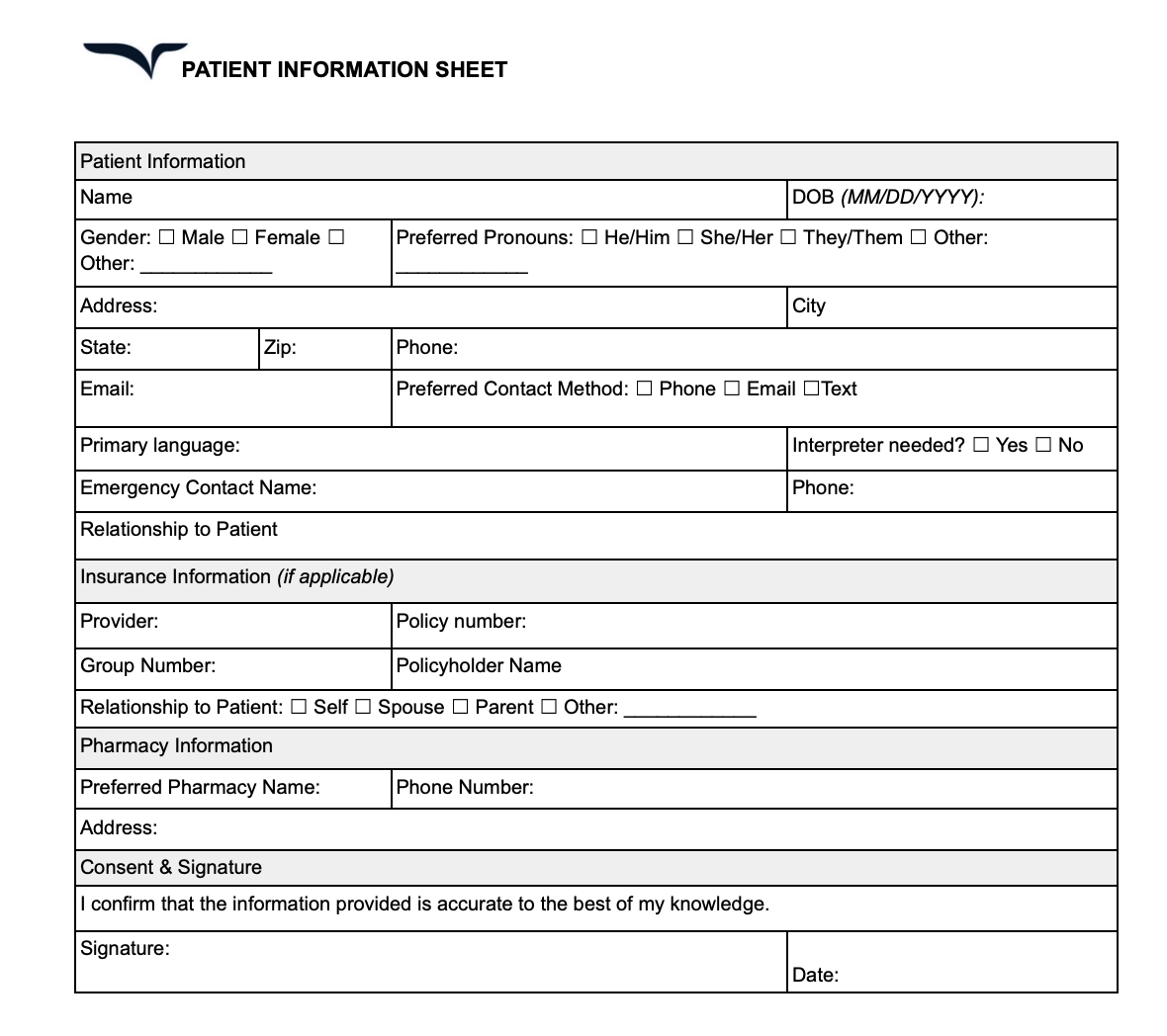
Want an even easier way to keep patient information organized beyond intake?
Once the below information is collected, Freed helps carry it through the rest of your documentation without adding extra work. You don’t need to build templates from scratch. Just paste in or upload a real example — like a note from your EHR or a past visit — and Freed will build a template that fits your note style, preferences, and practice.
If you’re starting from scratch, the Freed template library is a good place to begin. From there, you can adapt an existing template or create your own. As you document, toggle on Freed’s auto-learn feature so Freed can quietly pick up on your edits and refines your template over time so your notes stay consistent.
Patient information sheet example
Section 1: Patient information
This section collects a patient’s basic identifying information.
It ensures that medical records are attributed to the right patient and that all patient information is up-to-date.
Accuracy in this section is important for record-keeping, insurance processing, and enabling easy contact with patients.
- Social security number
- First name, last name, middle initial
- Date of birth
- Gender
- Marital status
- Address
- Home phone, work phone, cell phone
Section 2: Emergency contact
This section identifies an individual a patient trusts so healthcare providers can reach them in case of a medical emergency. Collecting this information is important as delays in contacting a family member, close friend, or caretaker can impact medical decisions.
- Name
- Relationship to patient
- Home phone, work phone, cell phone
Section 3: Insurance information
This section provides the necessary insurance details for moving billing and insurance claims forward.
The insurance information collected here is crucial for ensuring medical expenses are covered according to the patient’s insurance policy.
- Policyholder’s first name
- Policyholder’s last name
- Policyholder’s social security
- Policyholder’s date of birth
- Gender
- Relationship to policyholder
- Policyholder’s address
- Insurance name
- Policy ID
- Group #
Is there a secondary medical insurance provider? Yes/No
- If yes, name of insurance company:
- Policy ID:
- Group #:
- Policyholder’s first name:
- Policyholder’s last name:
- Policyholder’s social security:
- Policyholder’s date of birth:
- Relationship to policyholder:
Section 4: Signature
In this section, the patient will certify the accuracy of the information provided and acknowledge that they understand their financial responsibility, insurance obligations, and copay requirements.
I verify that the above information is factual and true to the best of my knowledge. I understand that proof of insurance and/or copay, if applicable, is due at the time of service.
Patient or Legal Guardian Signature:
Date:
Need more patient information?
If your practice requires a more detailed patient information sheet —including medical history, current medications, and lifestyle factors— our patient intake form template has you covered.
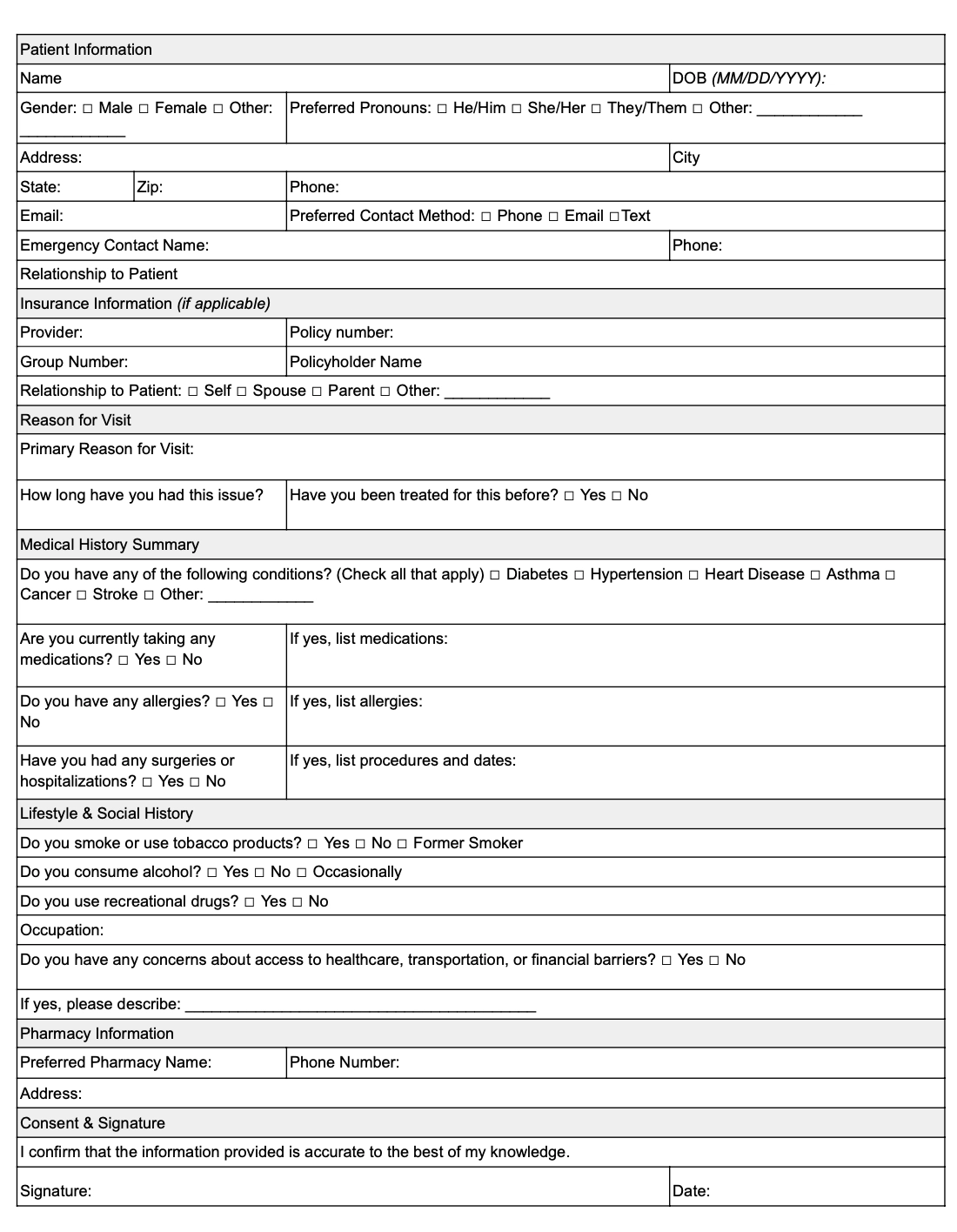
📌 Download the Patient Intake Form for a comprehensive, structured way to gather all the patient details you need for quality care.
Building a full intake packet? Pair this sheet with our medical history form, medical form templates, and patient report sheet.
Strengthen intake with Freed Front Desk
Collecting patient information is only one part of running an efficient practice. Front desk teams are also juggling missed calls, appointment requests, refill questions, insurance inquiries, and after-hours patient communication — often all at once.
Freed Front Desk helps clinics stay responsive without overwhelming staff. The AI receptionist answers patient calls 24/7, captures important details, and turns every conversation into an organized inbox entry your team can review and resolve quickly.
For small and midsized clinics, that means fewer missed calls, less administrative strain, and a smoother experience for both patients and staff.
Because when front desk communication runs smoothly, the rest of the patient experience does too.
Support the entire patient flow
Managing patient communication and documentation shouldn’t pull your team away from patient care.
Freed helps support both sides of the workflow. Freed Front Desk helps clinics answer calls, capture patient requests, and reduce front-office overload. Then Freed’s AI medical scribe helps clinicians document visits quickly and accurately — without the mental drain of charting after hours.
Together, they help small and midsized practices spend less time managing administrative work and more time focused on patients.Try it for free today.

Patient Information Sheet: Example & Downloadable Template
Table of Contents
Paperwork shouldn’t slow down patient care. A well-structured patient information sheet helps your team collect the right details upfront—without the back-and-forth.
This easy-to-use, downloadable template organizes key patient information, from demographics and insurance coverage to emergency contacts and medical history. With clear, standardized sections, it helps your team:
- Prevent billing errors by verifying insurance details early.
- Improve emergency response with up-to-date contact information.
- Ensure continuity of care by tracking past treatments, medications, and allergies.
Because better records mean better care — and less time spent on admin.
Download our free patient information sheet
Download the digital form to use online or print in practice.
Here's a breakdown of what you'll find in our patient information form.
Want an even easier way to keep patient information organized beyond intake?
Once the below information is collected, Freed helps carry it through the rest of your documentation without adding extra work. You don’t need to build templates from scratch. Just paste in or upload a real example — like a note from your EHR or a past visit — and Freed will build a template that fits your note style, preferences, and practice.
If you’re starting from scratch, the Freed template library is a good place to begin. From there, you can adapt an existing template or create your own. As you document, toggle on Freed’s auto-learn feature so Freed can quietly pick up on your edits and refines your template over time so your notes stay consistent.
Patient information sheet example
Section 1: Patient information
This section collects a patient’s basic identifying information.
It ensures that medical records are attributed to the right patient and that all patient information is up-to-date.
Accuracy in this section is important for record-keeping, insurance processing, and enabling easy contact with patients.
- Social security number
- First name, last name, middle initial
- Date of birth
- Gender
- Marital status
- Address
- Home phone, work phone, cell phone
Section 2: Emergency contact
This section identifies an individual a patient trusts so healthcare providers can reach them in case of a medical emergency. Collecting this information is important as delays in contacting a family member, close friend, or caretaker can impact medical decisions.
- Name
- Relationship to patient
- Home phone, work phone, cell phone
Section 3: Insurance information
This section provides the necessary insurance details for moving billing and insurance claims forward.
The insurance information collected here is crucial for ensuring medical expenses are covered according to the patient’s insurance policy.
- Policyholder’s first name
- Policyholder’s last name
- Policyholder’s social security
- Policyholder’s date of birth
- Gender
- Relationship to policyholder
- Policyholder’s address
- Insurance name
- Policy ID
- Group #
Is there a secondary medical insurance provider? Yes/No
- If yes, name of insurance company:
- Policy ID:
- Group #:
- Policyholder’s first name:
- Policyholder’s last name:
- Policyholder’s social security:
- Policyholder’s date of birth:
- Relationship to policyholder:
Section 4: Signature
In this section, the patient will certify the accuracy of the information provided and acknowledge that they understand their financial responsibility, insurance obligations, and copay requirements.
I verify that the above information is factual and true to the best of my knowledge. I understand that proof of insurance and/or copay, if applicable, is due at the time of service.
Patient or Legal Guardian Signature:
Date:
Need more patient information?
If your practice requires a more detailed patient information sheet —including medical history, current medications, and lifestyle factors— our patient intake form template has you covered.
📌 Download the Patient Intake Form for a comprehensive, structured way to gather all the patient details you need for quality care.
Building a full intake packet? Pair this sheet with our medical history form, medical form templates, and patient report sheet.
Strengthen intake with Freed Front Desk
Collecting patient information is only one part of running an efficient practice. Front desk teams are also juggling missed calls, appointment requests, refill questions, insurance inquiries, and after-hours patient communication — often all at once.
Freed Front Desk helps clinics stay responsive without overwhelming staff. The AI receptionist answers patient calls 24/7, captures important details, and turns every conversation into an organized inbox entry your team can review and resolve quickly.
For small and midsized clinics, that means fewer missed calls, less administrative strain, and a smoother experience for both patients and staff.
Because when front desk communication runs smoothly, the rest of the patient experience does too.
Support the entire patient flow
Managing patient communication and documentation shouldn’t pull your team away from patient care.
Freed helps support both sides of the workflow. Freed Front Desk helps clinics answer calls, capture patient requests, and reduce front-office overload. Then Freed’s AI medical scribe helps clinicians document visits quickly and accurately — without the mental drain of charting after hours.
Together, they help small and midsized practices spend less time managing administrative work and more time focused on patients.Try it for free today.
FAQs
Frequently asked questions from clinicians and medical practitioners.

What is a patient information sheet?

How to make a patient information sheet?
What are examples of patient information?
What is a patient data sheet?
Are AI scribes safe for sensitive patient information?
What information is collected during patient intake?
.avif)
Related content
Free yourself for better things


548 Market Street, PMB 95301
San Francisco, CA 94104
Specialties
Compliance & Security
Our technology is HIPAA-compliant, uses industry best practices, and doesn’t store patient recordings.