SOAP Note Template: 2026 Guide with Examples
Whether you're a medical student, resident, or practicing clinician, mastering the SOAP note is foundational to high-quality clinical documentation. In every patient encounter, the ability to translate a patient’s condition into a clear, structured narrative directly impacts continuity of care and treatment decisions.
A well-written SOAP note supports accurate medical record keeping, improves communication between health professionals, and strengthens clinical reasoning across care teams.
This guide breaks down the SOAP note into a practical, structured format while providing downloadable templates, examples, and best practices for real-world clinical workflows.
Free SOAP note template
Ready for the field? The SOAP methodology balances thoroughness with practicality.
Adapt this standard SOAP note example to your practice and specialty.
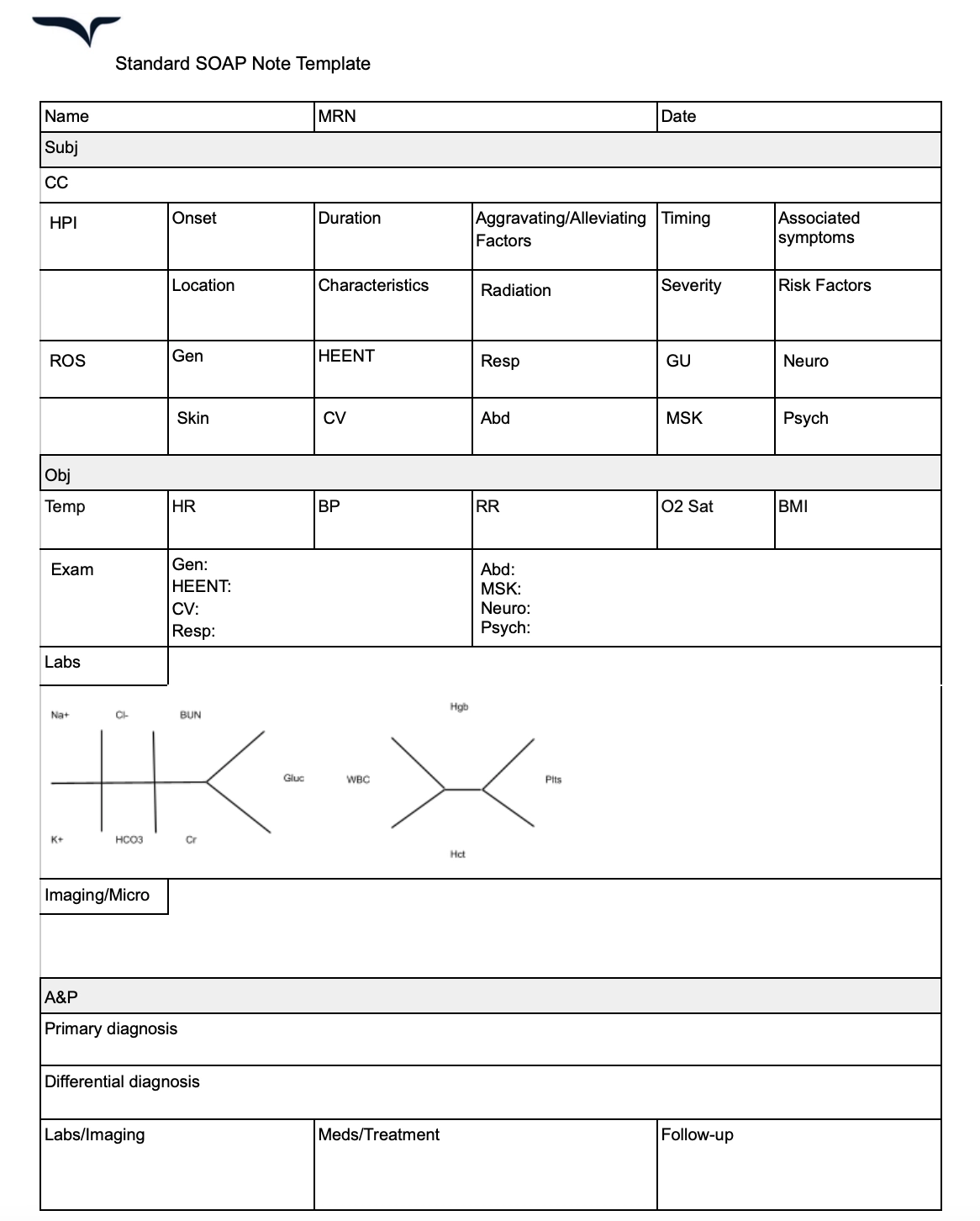
💡 Download for free: Download and use this standard SOAP note template here or the up/down version here
Free prerounding template
Before formal rounds, medical students and residents preround. You'll see patients, review charts, and formulate a plan.
When you come back with the attending, you'll present everything in SOAP format.
Prerounding is different than a standard SOAP note example— it's #1 goal is efficiency. Here you'll distill overnight changes, exam findings, and next steps into a format that’s quick to reference and easy to present on the spot.
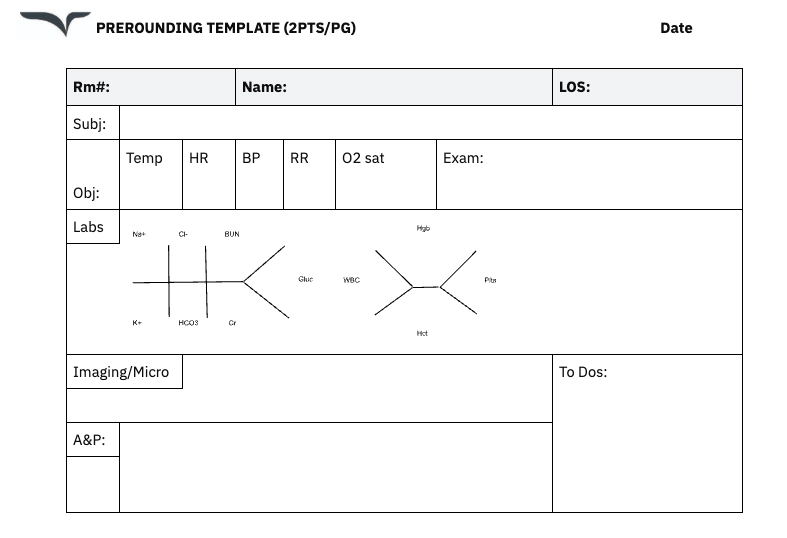
💡 Download for free: Get in Portrait 1pt/pg or Landscape 3pts/pg.
Save time with customized SOAP note templates
Convert your current SOAP notes into reusable templates in Freed. Upload a note, and Freed analyzes its layout, structure, and content to generate a template you can use across future visits (called "Learned Templates"). You can also browse and choose from Freed’s built-in template library. As you make edits over time, Freed continuously learns and updates your templates to better align with your workflow. Explore how templates can help standardize your documentation.
Why SOAP notes matter in clinical practice
The SOAP note is a standardized method for clinical documentation that ensures every patient encounter follows a consistent structured format. This improves the logical sequence of documentation and strengthens continuity of care.
For healthcare providers, the SOAP note is more than documentation—it is a framework for clinical reasoning, supporting accurate diagnosis, differential diagnosis, and informed treatment decisions.
In modern healthcare, healthcare providers rely on SOAP-based progress notes to ensure accurate representation of each patient encounter in the medical record.
What is a SOAP note?
A SOAP note is a standardized method used in clinical documentation that organizes the patient encounter. Dr. Larry Weed founded the SOAP methodology after a career in both medicine and scientific research. By peaking behind both curtains, he created "the problem list," a clear way to capture the patient and clinician's POV to find a diagnosis.
Based on the acronym, SOAP notes consist of four parts:
- subjective
- objective
- assessment
- plan
This structured format ensures that all subjective data, objective data, and clinical findings are captured in a logical sequence that supports clinical reasoning.
A SOAP note improves organized documentation, reduces missing information, and ensures clarity across healthcare providers.
SOAP note breakdown (With clinical detail)
SUBJECTIVE (Patient-reported information)
The subjective section of the SOAP note captures subjective data provided by the patient during the patient encounter.
The subjective section includes subjective interpretation of symptoms, chief complaint, and history of present illness. The subjective narrative is essential for understanding the patient’s condition.
In the subjective section, the patient describes symptoms, and the clinician records subjective data for the medical record. The subjective portion of the SOAP note ensures that clinical documentation reflects the patient history.
Common elements of the subjective section include:
- subjective report of symptoms
- subjective interpretation of discomfort
- subjective description of chief complaint
- subjective account of history of present illness
Accurate subjective documentation improves clinical reasoning and supports later assessment.
OBJECTIVE (Clinical findings and measurable data)
The objective section of the SOAP note contains objective data gathered by healthcare providers during the patient encounter.
The objective section includes physical examination, vital signs, and test results. The objective section provides measurable clinical findings that are not influenced by patient perception.
The objective portion of the SOAP note includes:
- objective data from physical examination
- objective data from vital signs
- objective data from test results
- objective data from imaging or labs
The objective section strengthens clinical documentation by ensuring measurable objective data is included in the medical record.
ASSESSMENT (Clinical reasoning and diagnosis)
The assessment section of the SOAP note represents the clinician’s clinical reasoning based on subjective data and objective data.
The assessment includes diagnosis, differential diagnosis, and interpretation of clinical findings. The assessment reflects how healthcare providers interpret the patient’s condition.
The assessment section supports:
- clinical reasoning
- formulation of diagnosis
- development of differential diagnosis
- synthesis of subjective and objective data
The assessment is central to clinical documentation, ensuring that each patient encounter leads to clear clinical insight.
A strong assessment improves treatment decisions and ensures consistency in the medical record.
PLAN (Treatment plan and plan of care)
The plan section of the SOAP note defines the treatment plan, plan of care, and next steps for the patient.
The plan includes:
- plan of care
- treatment plan
- treatment decisions
- follow-up instructions
- diagnostic orders
The plan translates the assessment into actionable steps. Each plan is based on clinical reasoning and ensures continuity of care. A clear plan supports communication between healthcare providers and improves outcomes for the patient.
SOAP note best practices
It's easy to micro-focus on the checklist in front of you, but that's not why you're entering healthcare.
Dr. Weed himself said, "We’re really not taking care of records; we’re taking care of people. . . . This record cannot be separated from the caring of that patient. . . . This is the practice of medicine.”
Dr. Shaun Ormond, who's dual board-certified in Anesthesiology and Interventional Pain Management, says to avoid these two mistakes:
"Don't ignore the patient's goals. Always check what the patient wants, whether it’s less pain, more mobility, or better sleep.
And don't forget daily function: Pain is more than a number—it’s about how it affects their life." — Dr. Shaun Ormond, Atlas Pain Specialists
To aid you in writing the best SOAP notes, you can try out the following:
- Strengthen clinical reasoning: Strong clinical reasoning ensures that the assessment reflects both subjective data and objective data from the patient encounter.
- Improve documentation consistency: Using a standardized method ensures all SOAP note entries follow a consistent structured format.
- Focus on patient-centered care: Every SOAP note should reflect the patient’s condition, including symptoms, clinical findings, and evolving diagnosis.
- Ensure continuity of care: Well-written progress notes improve continuity of care across healthcare providers.
Try an AI scribe for your SOAP notes
AI scribes (or AI medical scribes) are becoming the fastest way to get SOAP notes done.
Like any medical scribe, these tools listen in the background to transcribe and write notes in SOAP format.
Dr. Julie Johnson gave Freed a try. Here's what she has to say.
"My stress level has decreased significantly during my work day. I now have the freedom to just listen, ask questions, and focus on the patient and not on trying to capture the fine details of the visit."
More note templates
SOAP isn't the only format. Try our progress note template for ongoing care or the psychotherapy notes template for therapy sessions. You can also browse our patient notes templates. Want the structure filled in for you? See how AI scribe templates work.
Ready to make the most out of your SOAP notes?
The key to SOAP notes isn’t just what you write, but how efficiently you capture what matters—for your patients, your team, and yourself.
Download the templates, apply best practices, and find a system that works for you — because great notes don’t just check a box, they improve patient care.

Table of Contents
Whether you're a medical student, resident, or practicing clinician, mastering the SOAP note is foundational to high-quality clinical documentation. In every patient encounter, the ability to translate a patient’s condition into a clear, structured narrative directly impacts continuity of care and treatment decisions.
A well-written SOAP note supports accurate medical record keeping, improves communication between health professionals, and strengthens clinical reasoning across care teams.
This guide breaks down the SOAP note into a practical, structured format while providing downloadable templates, examples, and best practices for real-world clinical workflows.
Free SOAP note template
Ready for the field? The SOAP methodology balances thoroughness with practicality.
Adapt this standard SOAP note example to your practice and specialty.
💡 Download for free: Download and use this standard SOAP note template here or the up/down version here
Free prerounding template
Before formal rounds, medical students and residents preround. You'll see patients, review charts, and formulate a plan.
When you come back with the attending, you'll present everything in SOAP format.
Prerounding is different than a standard SOAP note example— it's #1 goal is efficiency. Here you'll distill overnight changes, exam findings, and next steps into a format that’s quick to reference and easy to present on the spot.
💡 Download for free: Get in Portrait 1pt/pg or Landscape 3pts/pg.
Save time with customized SOAP note templates
Convert your current SOAP notes into reusable templates in Freed. Upload a note, and Freed analyzes its layout, structure, and content to generate a template you can use across future visits (called "Learned Templates"). You can also browse and choose from Freed’s built-in template library. As you make edits over time, Freed continuously learns and updates your templates to better align with your workflow. Explore how templates can help standardize your documentation.
Why SOAP notes matter in clinical practice
The SOAP note is a standardized method for clinical documentation that ensures every patient encounter follows a consistent structured format. This improves the logical sequence of documentation and strengthens continuity of care.
For healthcare providers, the SOAP note is more than documentation—it is a framework for clinical reasoning, supporting accurate diagnosis, differential diagnosis, and informed treatment decisions.
In modern healthcare, healthcare providers rely on SOAP-based progress notes to ensure accurate representation of each patient encounter in the medical record.
What is a SOAP note?
A SOAP note is a standardized method used in clinical documentation that organizes the patient encounter. Dr. Larry Weed founded the SOAP methodology after a career in both medicine and scientific research. By peaking behind both curtains, he created "the problem list," a clear way to capture the patient and clinician's POV to find a diagnosis.
Based on the acronym, SOAP notes consist of four parts:
- subjective
- objective
- assessment
- plan
This structured format ensures that all subjective data, objective data, and clinical findings are captured in a logical sequence that supports clinical reasoning.
A SOAP note improves organized documentation, reduces missing information, and ensures clarity across healthcare providers.
SOAP note breakdown (With clinical detail)
SUBJECTIVE (Patient-reported information)
The subjective section of the SOAP note captures subjective data provided by the patient during the patient encounter.
The subjective section includes subjective interpretation of symptoms, chief complaint, and history of present illness. The subjective narrative is essential for understanding the patient’s condition.
In the subjective section, the patient describes symptoms, and the clinician records subjective data for the medical record. The subjective portion of the SOAP note ensures that clinical documentation reflects the patient history.
Common elements of the subjective section include:
- subjective report of symptoms
- subjective interpretation of discomfort
- subjective description of chief complaint
- subjective account of history of present illness
Accurate subjective documentation improves clinical reasoning and supports later assessment.
OBJECTIVE (Clinical findings and measurable data)
The objective section of the SOAP note contains objective data gathered by healthcare providers during the patient encounter.
The objective section includes physical examination, vital signs, and test results. The objective section provides measurable clinical findings that are not influenced by patient perception.
The objective portion of the SOAP note includes:
- objective data from physical examination
- objective data from vital signs
- objective data from test results
- objective data from imaging or labs
The objective section strengthens clinical documentation by ensuring measurable objective data is included in the medical record.
ASSESSMENT (Clinical reasoning and diagnosis)
The assessment section of the SOAP note represents the clinician’s clinical reasoning based on subjective data and objective data.
The assessment includes diagnosis, differential diagnosis, and interpretation of clinical findings. The assessment reflects how healthcare providers interpret the patient’s condition.
The assessment section supports:
- clinical reasoning
- formulation of diagnosis
- development of differential diagnosis
- synthesis of subjective and objective data
The assessment is central to clinical documentation, ensuring that each patient encounter leads to clear clinical insight.
A strong assessment improves treatment decisions and ensures consistency in the medical record.
PLAN (Treatment plan and plan of care)
The plan section of the SOAP note defines the treatment plan, plan of care, and next steps for the patient.
The plan includes:
- plan of care
- treatment plan
- treatment decisions
- follow-up instructions
- diagnostic orders
The plan translates the assessment into actionable steps. Each plan is based on clinical reasoning and ensures continuity of care. A clear plan supports communication between healthcare providers and improves outcomes for the patient.
SOAP note best practices
It's easy to micro-focus on the checklist in front of you, but that's not why you're entering healthcare.
Dr. Weed himself said, "We’re really not taking care of records; we’re taking care of people. . . . This record cannot be separated from the caring of that patient. . . . This is the practice of medicine.”
Dr. Shaun Ormond, who's dual board-certified in Anesthesiology and Interventional Pain Management, says to avoid these two mistakes:
"Don't ignore the patient's goals. Always check what the patient wants, whether it’s less pain, more mobility, or better sleep.
And don't forget daily function: Pain is more than a number—it’s about how it affects their life." — Dr. Shaun Ormond, Atlas Pain Specialists
To aid you in writing the best SOAP notes, you can try out the following:
- Strengthen clinical reasoning: Strong clinical reasoning ensures that the assessment reflects both subjective data and objective data from the patient encounter.
- Improve documentation consistency: Using a standardized method ensures all SOAP note entries follow a consistent structured format.
- Focus on patient-centered care: Every SOAP note should reflect the patient’s condition, including symptoms, clinical findings, and evolving diagnosis.
- Ensure continuity of care: Well-written progress notes improve continuity of care across healthcare providers.
Try an AI scribe for your SOAP notes
AI scribes (or AI medical scribes) are becoming the fastest way to get SOAP notes done.
Like any medical scribe, these tools listen in the background to transcribe and write notes in SOAP format.
Dr. Julie Johnson gave Freed a try. Here's what she has to say.
"My stress level has decreased significantly during my work day. I now have the freedom to just listen, ask questions, and focus on the patient and not on trying to capture the fine details of the visit."
More note templates
SOAP isn't the only format. Try our progress note template for ongoing care or the psychotherapy notes template for therapy sessions. You can also browse our patient notes templates. Want the structure filled in for you? See how AI scribe templates work.
Ready to make the most out of your SOAP notes?
The key to SOAP notes isn’t just what you write, but how efficiently you capture what matters—for your patients, your team, and yourself.
Download the templates, apply best practices, and find a system that works for you — because great notes don’t just check a box, they improve patient care.
FAQs
Frequently asked questions from clinicians and medical practitioners.

What are the four parts of a SOAP note?

How to write SOAP method?
Can ChatGPT write SOAP notes?
How does SOAP note AI work?

Related content
Free yourself for better things


548 Market Street, PMB 95301
San Francisco, CA 94104
Specialties
Compliance & Security
Our technology is HIPAA-compliant, uses industry best practices, and doesn’t store patient recordings.