Treatment Plan Templates: Free Guide & Downloadable Examples
Writing treatment plans shouldn’t feel like a time sink.
Yet somehow, you’re always hunting for the right template or starting from scratch — again. It takes longer than it should, and when time is tight, that’s the last thing you need.
The reality is this: a strong treatment plan does more than satisfy documentation requirements. It creates alignment across the care team, improves communication with the patient, supports measurable goals, and gives clinicians a clear roadmap for tracking progress over time.
That’s why high-quality treatment plans matter.
In this guide, we’ll break down:
- What makes an effective treatment plan
- The core sections every treatment plan should include
- Common mistakes clinicians make during treatment planning
- Real-world examples and treatment goals
- Five free treatment plan templates for different specialties
- How AI documentation tools like Freed can simplify the treatment process
Along the way, we’ll also cover best practices used by therapists, psychiatrists, primary care clinicians, and other healthcare professionals managing complex patient needs.
P.S. A few other things worth keeping in your back pocket: a rock-solid coffee order, the best snack in your desk drawer, and a playlist that keeps you focused without lulling you to sleep.
What is a treatment plan?
A treatment plan is a structured clinical document that maps out a patient's path from diagnosis to desired outcomes. It's the bridge between assessment and action for physician and patient. While SOAP notes document single visits, plans monitor ongoing care. Most treatment plans include:
- Diagnosis — the clinical condition(s) being addressed
- Presenting problems — the specific symptoms or challenges the patient is experiencing
- Goals — broad, meaningful outcomes the patient is working toward (e.g., "reduce anxiety to a manageable level")
- Objectives — measurable, time-bound milestones that track progress toward each goal (e.g., "practice one grounding technique daily for 4 weeks")
- Interventions — the specific techniques, therapies, or actions the clinician will use (e.g., CBT, motivational interviewing, medication management)
- Timeline and review dates — when the plan will be reassessed and updated
Treatment plans aren't one-and-done. They're updated as the patient progresses, goals shift, or new information comes to light. In many specialties, especially mental and behavioral health, a current treatment plan is required for insurance reimbursement and regulatory compliance. When written with the right framework, it keeps your team aligned, helps patients stay on track, and reduces the administrative burden that comes with disorganized records.
The challenge? Writing and maintaining treatment plans is one of the most time-consuming parts of c
5 free treatment plan templates
Here are five common templates clinicians can adapt for their workflows. All five specialty templates below are available as downloadable PDFs.
Or skip the download entirely — Freed generates your treatment plan documentation automatically from your visit audio.
Start your free trial →
1. Standard treatment plan template
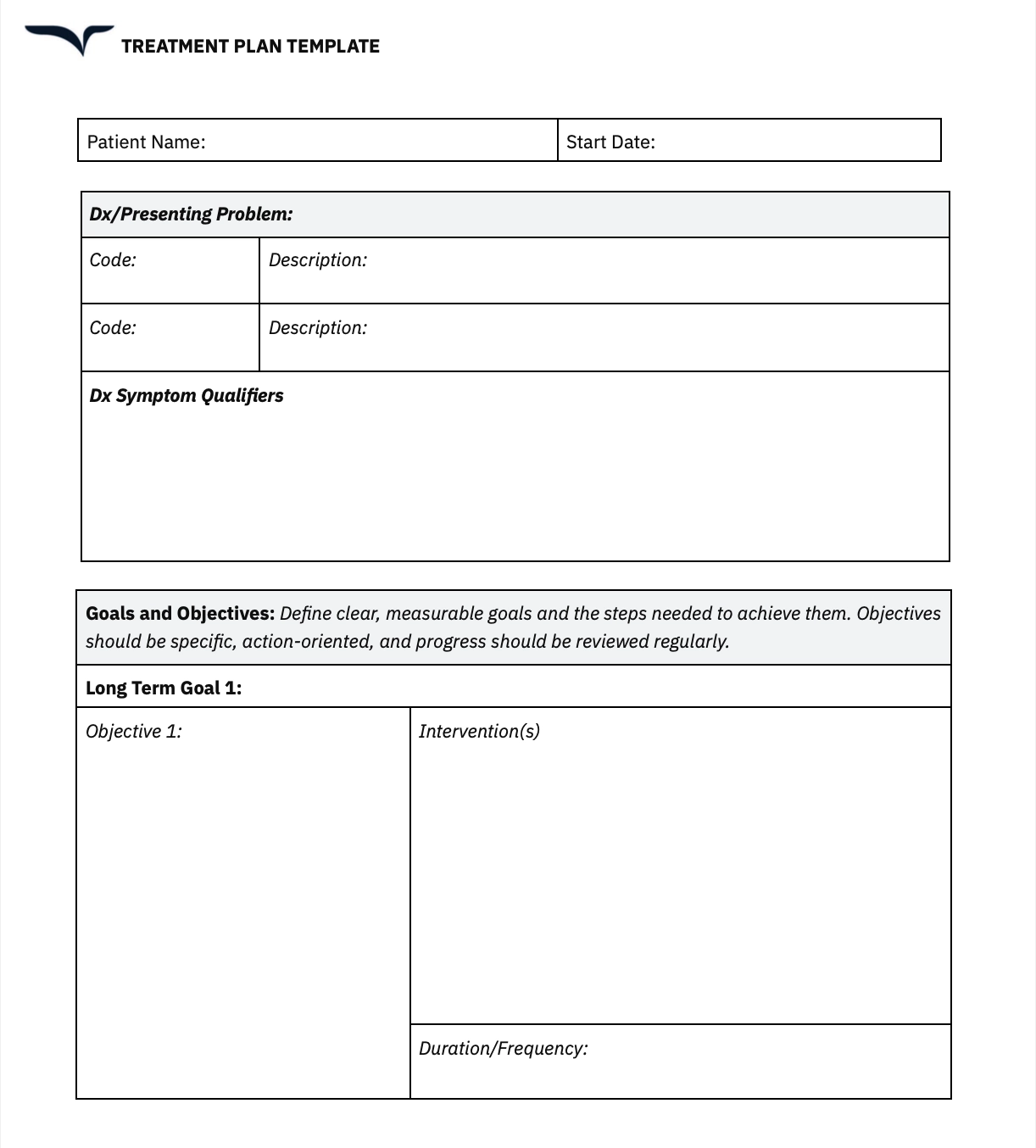
Standard treatment plan template: key sections
- Presenting problem
- Diagnosis and symptom qualifiers
- Treatment goals
- Objectives and interventions
- Progress tracking metrics
- Timeline and reassessment schedule
- Provider attestation
Best uses and clinical applications
This flexible treatment plan works well across specialties because it creates a clear structure without being overly restrictive.
Standard treatment plan example
A healthcare professional treating hypertension and obesity can document measurable goals like lowering blood pressure readings within 90 days while outlining interventions involving medication adherence, nutrition counseling, and exercise recommendations.
The structure also improves communication across providers participating in the patient’s care.
📌 Best for: General medical practices, outpatient clinics, rehabilitation settings, and multidisciplinary care teams.
2. Mental health treatment plan template
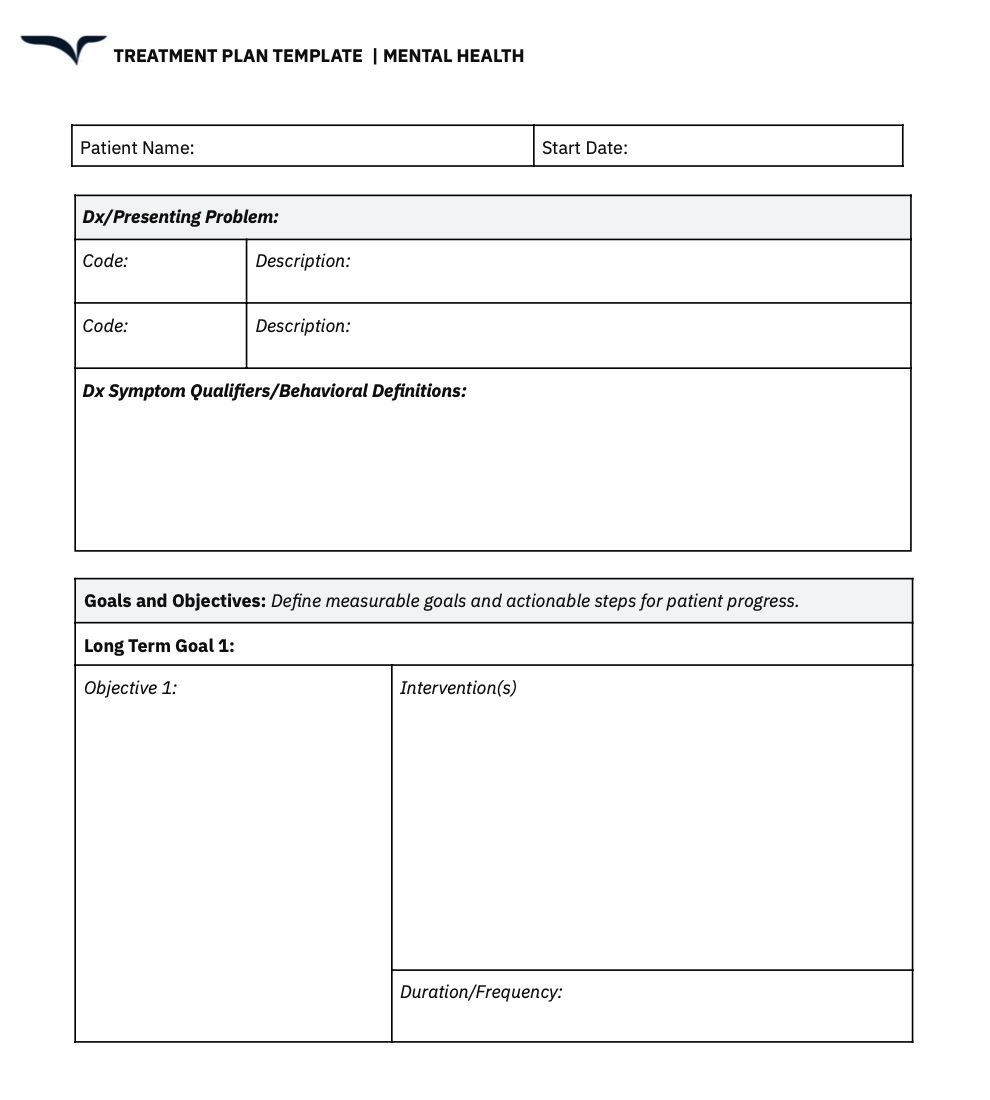
Mental health treatment plan: required documentation fields
- Mental health diagnosis
- Presenting problems and behavioral observations
- Emotional and cognitive symptoms
- SMART treatment goals
- Therapy interventions
- Progress tracking schedule
- Risk assessment documentation
Best uses and clinical applications
Mental health treatment requires consistent documentation of emotional, behavioral, and functional changes over time.
A structured treatment plan helps clinicians monitor symptoms while supporting insurance documentation and continuity of care.
Mental health treatment example
A client presents with generalized anxiety disorder and reports panic symptoms affecting work performance.
Treatment goals may include:
- Reducing panic episodes from daily occurrences to once weekly within eight weeks
- Improving sleep quality
- Increasing workplace attendance
Interventions may include:
- Cognitive behavioral therapy
- Cognitive restructuring
- Exposure therapy
- Coping strategies, such as breathing exercises
- Medication management collaboration with psychiatry
Progress tracking might include GAD-7 scoring, session feedback, and behavioral observations.
📌 Best for: Therapists, counselors, psychologists, and behavioral health providers.
3. Psychiatry treatment plan template
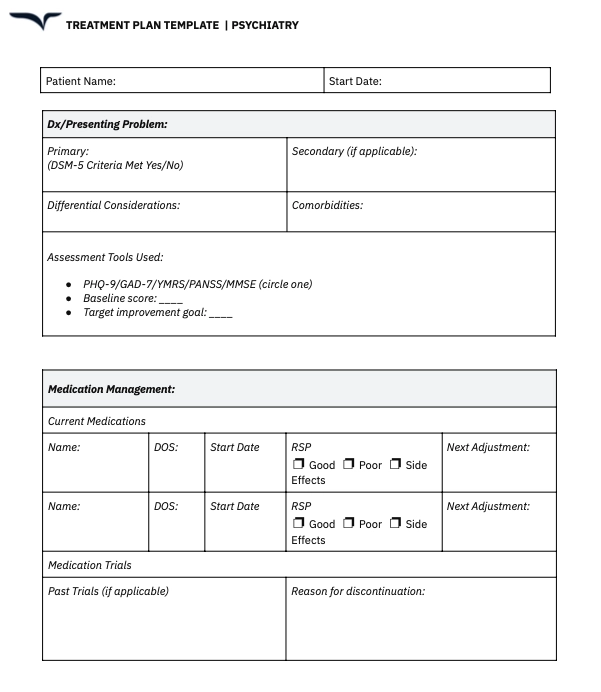
Psychiatry treatment plan: required documentation fields
- DSM-5 diagnosis
- Presenting problem documentation
- Medication history
- Symptom severity scales
- Treatment goals and medication objectives
- Side effect monitoring
- Progress tracking and reassessment intervals
Best uses and clinical applications
Psychiatric treatment plans often involve ongoing medication adjustments, symptom monitoring, and collaboration with therapists or primary care teams.
A detailed treatment plan supports safer medication management while improving visibility into the patient’s progress.
Psychiatry treatment example
A patient with major depressive disorder may require:
- PHQ-9 monitoring
- Weekly therapy sessions
- Medication titration documentation
- Suicide risk assessments
- Sleep and appetite monitoring
The treatment process becomes much easier when clinicians can quickly review previous interventions, outcomes, and symptom changes in one place.
📌 Best for: Psychiatrists and clinicians managing medication-based mental health treatment.
4. Chronic pain management treatment plan template
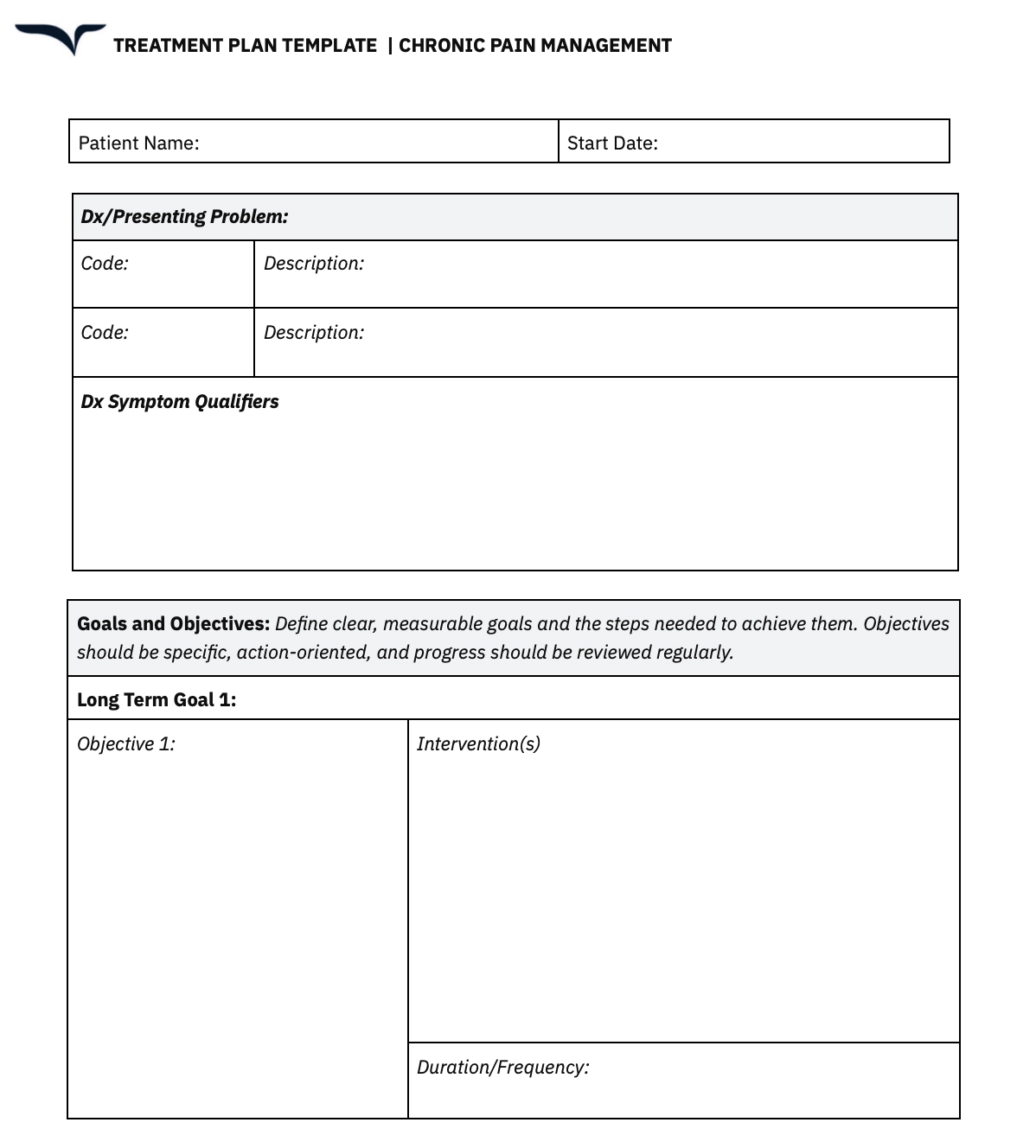
Chronic pain management: key sections
- Diagnosis and pain history
- Functional limitations
- Long-term and short-term treatment goals
- Medication and non-pharmacologic interventions
- Mobility benchmarks
- Progress tracking documentation
- Insurance compliance requirements
Best uses and clinical applications
Chronic pain treatment planning requires multidisciplinary coordination and detailed documentation.
A patient with lower back pain may need:
- Physical therapy
- Medication adjustments
- Stretching programs
- Behavioral health support
- Functional mobility assessments
Without a structured treatment plan, it becomes difficult to measure progress or justify modifications to care.
Chronic pain management example
SMART goal:
Reduce pain severity from 8/10 to 4/10 within six weeks while improving the patient’s ability to sit for longer than 45 minutes.
Objectives:
- Attend physical therapy twice weekly
- Complete daily stretching exercises
- Track pain levels each evening
Interventions:
- Guided mobility exercises
- Anti-inflammatory medication management
- Ergonomic education
📌 Best for: Pain specialists, physical therapists, primary care teams, and rehabilitation clinics.
5. Substance use disorder (SUD) treatment plan template
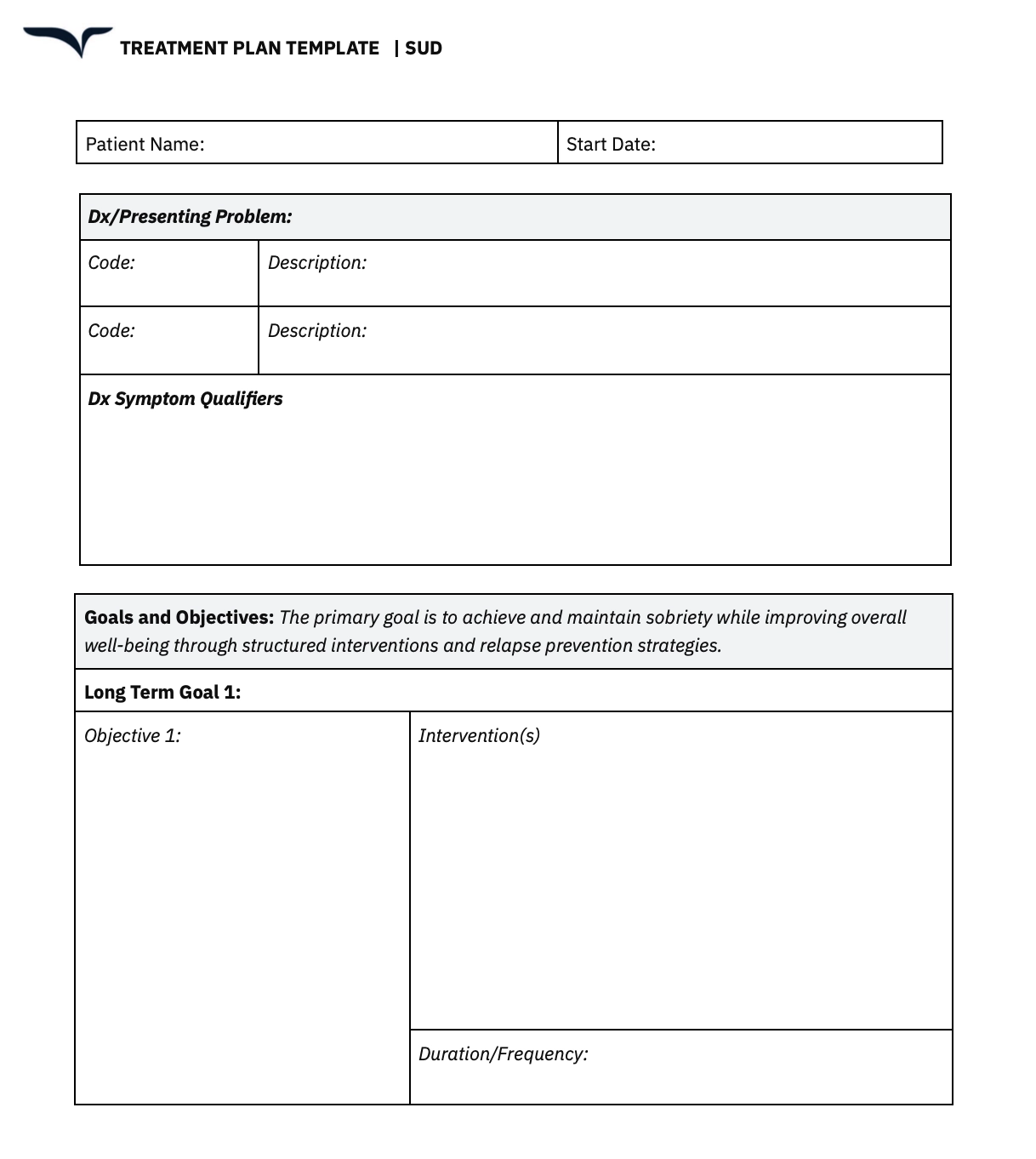
SUD treatment plan: key sections
- Substance use history
- Presenting problems and triggers
- Recovery-focused treatment goals
- Relapse prevention objectives
- MAT documentation
- Community support planning
- Progress tracking and reassessment
Best uses and clinical applications
Substance use recovery is rarely linear.
Clinicians need treatment plans that support accountability while documenting setbacks, behavioral activation, social support systems, and ongoing interventions.
SUD treatment example
A client beginning opioid recovery treatment may have measurable goals tied to:
- Maintaining sobriety milestones
- Attending support groups
- Participating in weekly therapy
- Improving housing stability
Progress tracking often includes toxicology screening, attendance records, and self-reported symptom changes.
📌 Best for: Addiction specialists, behavioral health teams, and Medication-Assisted Treatment (MAT) clinics.
What should a treatment plan include?
Here's a breakdown of what you'll find in a standard treatment plan template.
1. Background information
Start with relevant context. This section should include:
- Patient demographics
- Relevant medical history
- Prior diagnosis information
- Previous treatment outcomes
- Medication history
- Functional limitations
- Social or environmental factors affecting care
Strong treatment planning starts with understanding the full clinical picture.
2. Presenting problem
The presenting problem explains why the patient or client is seeking treatment.
Common presenting problems may include:
- Anxiety symptoms
- Chronic pain
- Sleep disturbances
- Depression
- Substance use concerns
- Mobility limitations
Clearly documenting presenting problems helps guide treatment goals and clinical decision-making.
3. Treatment goals
Treatment goals define what success looks like.
The strongest treatment goals are:
- Specific
- Measurable
- Clinically relevant
- Time-bound
- Realistic for the patient
For example:
Instead of writing “Improve anxiety,” a clinician might document:
“Reduce panic attacks from daily episodes to fewer than two per week within eight weeks.”
Measurable goals improve accountability for both the clinician and patient.
4. Objectives
Objectives break larger treatment goals into smaller actionable steps.
Good objectives are concrete and observable.
Examples include:
- Attend therapy sessions weekly
- Complete daily stretching exercises
- Take medication consistently
- Practice breathing exercises twice daily
Objectives help organize the treatment process and support progress tracking over time.
5. Interventions
Interventions describe what clinicians will actually do during treatment.
Depending on the specialty, interventions may include:
- Cognitive behavioral therapy
- Medication management
- Lifestyle counseling
- Physical rehabilitation
- Motivational interviewing
- Nutrition education
- Exposure therapy
The treatment plan should clearly document frequency, duration, and responsibilities for each intervention.
6. Progress tracking
Progress tracking helps clinicians evaluate whether treatment goals are being achieved.
Strong progress tracking includes:
- Baseline measurements
- Symptom rating scales
- Functional assessments
- Patient-reported outcomes
- Behavioral observations
- Reevaluation timelines
Without progress tracking, clinicians risk continuing ineffective interventions longer than necessary.
Common treatment planning mistakes
Even experienced clinicians run into challenges when building treatment plans.
Here are some of the most common issues.
- Writing vague treatment goals: Goals like “feel better” or “improve mood” make progress difficult to measure. Measurable goals improve clinical clarity and documentation quality.
- Overcomplicating documentation: Treatment plans should support clinical workflows — not slow them down. Excessive narrative detail can make the treatment process harder to follow.
- Failing to update treatment plans: A treatment plan should evolve alongside the patient’s condition. If symptoms worsen or interventions stop working, the documentation should reflect those changes.
- Missing collaboration opportunities: Many patients receive care from multiple providers. Strong treatment planning supports collaboration between therapists, physicians, psychiatrists, case managers, and specialists.
The impact of an effective treatment plan
Lost time isn’t always about difficulty — it’s often about unclear instructions.
If you’ve ever spent more time decoding notes than seeing a patient, you know the pain of poor treatment planning.
It doesn’t need to be complicated or groundbreaking — it just needs to be clear. That means better outcomes for your patient, and consistent efficiency gains for you and your medical team over time.
If that’s not convincing enough, here are some other benefits:
- Improves treatment success rate: A structured plan keeps you accountable. You document methods and frameworks that align all stakeholders and introduce the right amount of urgency. Communication improves, and so does your likelihood of achieving set objectives.
- Prevents last-minute scrambles for documentation: Stop scrambling for documentation during audits or insurance reviews. A structured treatment plan saves time — and your sanity. A good treatment plan keeps all essential details and data in one place.
- Adds proof and justification for any changes to proposed interventions: Treatment plans don’t always go as planned, but resistance to change and adjustments can be a big source of stress. Clearly written documentation helps you show stakeholders what is and isn’t working to minimize pushback and delays.
How to create a treatment plan
We’ve covered all the key sections that make up an effective treatment plan.
Now, let’s break each section down into checklist items that can help you simplify content organization and structure.
Step 1: Begin with a comprehensive assessment
Let's understand the lay of the land before putting down any building blocks.
What's the problem you're trying to solve?
Beyond the basic demographic details of your patient, gather all information that could help you evaluate the present concern.
This includes:
- Medical history
- Client's symptoms and their severity
- All results from tests and evaluations of these symptoms
- Past diagnoses and treatment outcomes
- The patient’s presenting problem
Step 2: Define what you want to measure
A good treatment plan needs clear points of action, from larger, measurable goals to smaller objectives. SMART goals keep your plan actionable. They are:
- Specific: Clearly state what you want to achieve with this treatment.
- Measurable: Use quantifiable metrics to track progress over time.
- Achievable: Keep goals realistic so they’re within the patient’s capabilities.
- Relevant: Align goals with the patient’s presenting problem
- Time-bound: Set timeframes for completing your goals.
With a realistic and measurable goal on hand, building detailed objectives is simple. Here’s an example:
SMART goal: A middle-aged woman presents with chronic lower back pain. The goal of this treatment plan is to reduce her pain levels from 7/10 to 3/10 within six weeks.
Objective 1: Attend physical therapy sessions twice a week for the next month to improve strength and flexibility in the lower back and core muscles.
Objective 2: Perform prescribed home exercises and stretches for 15 minutes daily for the next four weeks.
Step 3: Describe specific interventions
Your treatment plan is incomplete if it doesn’t guide the reader through key milestones.
When writing about your interventions, remember to outline:
- The specific method, therapy, or strategy you'll use.
- The frequency, duration, and specific techniques needed to administer the intervention correctly. For example, saying “Complete three sets of 10 reps of prescribed gentle stretches” instead of “Stretch daily.”
- Clear indication of who does what, be it the healthcare provider or patient.
Step 4: Set timelines to stay on track
Have you ever heard the phrase, a goal without a timeline is just a dream? Root your treatment planning in reality and urgency. Timelines help hold both therapist and client accountable. Complete your treatment plan by clearly outlining:
- Goals and objectives
- Milestone deadlines
- A date to revisit progress
Step 5: Create room to track progress
Finally, wrap up your treatment plan with clear success metrics. List important milestones that patients and medical staff should look for throughout treatment.
For example: Let's say your patient's chief complaint is lower back pain.
Your progress evaluation might describe how patients monitor their pain and mobility over time. In short, this section should include:
- Qualitative and quantitative measures of improvement — like rating scales, numerical metrics, or prompt questions
- Baseline data to serve as a reference point for progress tracking
- Benchmarks to track throughout the treatment plan
- Criteria for plan reevaluation if progress starts to decline
How Freed autogenerates treatment plans
AI documentation tools are changing how clinicians manage treatment planning. Instead of manually organizing every presenting problem, intervention, and progress note, clinicians can use AI-assisted workflows to reduce administrative burden.
You can use your real patient notes to make hyper-personalized templates in Freed. Simply upload a note in Freed, and Freed analyzes its structure, formatting, and content, saving it as an example note. Your notes will be the basis for template plans that you add to the A&P, or generate with our clinician assistant.
| Treatment plan task | Template alone | Template + Freed |
|---|---|---|
| Starting the treatment plan | Hunt for the right template or start from scratch — again. | Upload or capture an intake note and Freed can generate a structured treatment plan. Add treatment plan details to your A&P with the clinician assistant. |
| Capturing goals and interventions | Written manually after the visit from recall. Specifics — frequency, duration, techniques — are the first details to get compressed. | Freed captures goals, objectives, and intervention details from the encounter as they're spoken — nothing reconstructed after the fact. |
| Specialty fit | Generic templates need manual edits for mental health, psychiatry, chronic pain, or SUD workflows. | Freed's template library includes specialty-specific formats. Choose one, edit it, and Freed learns your preferences over time. |
| Progress tracking across visits | Updated manually each visit. Easy to lose consistency when notes are written under time pressure. | Freed learns from your edits and keeps your documentation consistent visit to visit — no reformatting, no starting over. |
| Documentation burden | Treatment plans follow clinicians home. Time spent on paperwork is time not spent on patients. | Freed turns your spoken encounter into a structured, clinician-ready treatment plan draft. Review and finalize, instead of writing from scratch. |
HIPAA compliance and documentation security
Healthcare professionals should always verify that treatment planning tools meet organizational privacy and security requirements.
Treatment plans often contain highly sensitive patient information, especially within mental health treatment and behavioral health settings.
When evaluating documentation software, clinicians should confirm:
- HIPAA compliance
- Secure data storage
- Role-based access controls
- Audit logging
- Encryption standards
- Organizational policy alignment
Related templates
Treatment plans work best alongside your session documentation. Pair yours with a progress note template to track each visit. Use a psychotherapy notes template for private clinical reflection. Need a recap for another provider? Try a clinical summary template.
Ready to level up your treatment plans?
Freed helps clinicians spend less time documenting and more time doing what they love. Get started today!
Disclaimer: This article is for informational purposes only and does not constitute legal or clinical advice. Clinicians should follow applicable laws, regulations, and institutional policies when creating or sharing treatment plans.

Treatment Plan Templates: Free Guide & Downloadable Examples
Table of Contents
Writing treatment plans shouldn’t feel like a time sink.
Yet somehow, you’re always hunting for the right template or starting from scratch — again. It takes longer than it should, and when time is tight, that’s the last thing you need.
The reality is this: a strong treatment plan does more than satisfy documentation requirements. It creates alignment across the care team, improves communication with the patient, supports measurable goals, and gives clinicians a clear roadmap for tracking progress over time.
That’s why high-quality treatment plans matter.
In this guide, we’ll break down:
- What makes an effective treatment plan
- The core sections every treatment plan should include
- Common mistakes clinicians make during treatment planning
- Real-world examples and treatment goals
- Five free treatment plan templates for different specialties
- How AI documentation tools like Freed can simplify the treatment process
Along the way, we’ll also cover best practices used by therapists, psychiatrists, primary care clinicians, and other healthcare professionals managing complex patient needs.
P.S. A few other things worth keeping in your back pocket: a rock-solid coffee order, the best snack in your desk drawer, and a playlist that keeps you focused without lulling you to sleep.
What is a treatment plan?
A treatment plan is a structured clinical document that maps out a patient's path from diagnosis to desired outcomes. It's the bridge between assessment and action for physician and patient. While SOAP notes document single visits, plans monitor ongoing care. Most treatment plans include:
- Diagnosis — the clinical condition(s) being addressed
- Presenting problems — the specific symptoms or challenges the patient is experiencing
- Goals — broad, meaningful outcomes the patient is working toward (e.g., "reduce anxiety to a manageable level")
- Objectives — measurable, time-bound milestones that track progress toward each goal (e.g., "practice one grounding technique daily for 4 weeks")
- Interventions — the specific techniques, therapies, or actions the clinician will use (e.g., CBT, motivational interviewing, medication management)
- Timeline and review dates — when the plan will be reassessed and updated
Treatment plans aren't one-and-done. They're updated as the patient progresses, goals shift, or new information comes to light. In many specialties, especially mental and behavioral health, a current treatment plan is required for insurance reimbursement and regulatory compliance. When written with the right framework, it keeps your team aligned, helps patients stay on track, and reduces the administrative burden that comes with disorganized records.
The challenge? Writing and maintaining treatment plans is one of the most time-consuming parts of c
5 free treatment plan templates
Here are five common templates clinicians can adapt for their workflows. All five specialty templates below are available as downloadable PDFs.
Or skip the download entirely — Freed generates your treatment plan documentation automatically from your visit audio.
Start your free trial →
1. Standard treatment plan template
Standard treatment plan template: key sections
- Presenting problem
- Diagnosis and symptom qualifiers
- Treatment goals
- Objectives and interventions
- Progress tracking metrics
- Timeline and reassessment schedule
- Provider attestation
Best uses and clinical applications
This flexible treatment plan works well across specialties because it creates a clear structure without being overly restrictive.
Standard treatment plan example
A healthcare professional treating hypertension and obesity can document measurable goals like lowering blood pressure readings within 90 days while outlining interventions involving medication adherence, nutrition counseling, and exercise recommendations.
The structure also improves communication across providers participating in the patient’s care.
📌 Best for: General medical practices, outpatient clinics, rehabilitation settings, and multidisciplinary care teams.
2. Mental health treatment plan template
Mental health treatment plan: required documentation fields
- Mental health diagnosis
- Presenting problems and behavioral observations
- Emotional and cognitive symptoms
- SMART treatment goals
- Therapy interventions
- Progress tracking schedule
- Risk assessment documentation
Best uses and clinical applications
Mental health treatment requires consistent documentation of emotional, behavioral, and functional changes over time.
A structured treatment plan helps clinicians monitor symptoms while supporting insurance documentation and continuity of care.
Mental health treatment example
A client presents with generalized anxiety disorder and reports panic symptoms affecting work performance.
Treatment goals may include:
- Reducing panic episodes from daily occurrences to once weekly within eight weeks
- Improving sleep quality
- Increasing workplace attendance
Interventions may include:
- Cognitive behavioral therapy
- Cognitive restructuring
- Exposure therapy
- Coping strategies, such as breathing exercises
- Medication management collaboration with psychiatry
Progress tracking might include GAD-7 scoring, session feedback, and behavioral observations.
📌 Best for: Therapists, counselors, psychologists, and behavioral health providers.
3. Psychiatry treatment plan template
Psychiatry treatment plan: required documentation fields
- DSM-5 diagnosis
- Presenting problem documentation
- Medication history
- Symptom severity scales
- Treatment goals and medication objectives
- Side effect monitoring
- Progress tracking and reassessment intervals
Best uses and clinical applications
Psychiatric treatment plans often involve ongoing medication adjustments, symptom monitoring, and collaboration with therapists or primary care teams.
A detailed treatment plan supports safer medication management while improving visibility into the patient’s progress.
Psychiatry treatment example
A patient with major depressive disorder may require:
- PHQ-9 monitoring
- Weekly therapy sessions
- Medication titration documentation
- Suicide risk assessments
- Sleep and appetite monitoring
The treatment process becomes much easier when clinicians can quickly review previous interventions, outcomes, and symptom changes in one place.
📌 Best for: Psychiatrists and clinicians managing medication-based mental health treatment.
4. Chronic pain management treatment plan template
Chronic pain management: key sections
- Diagnosis and pain history
- Functional limitations
- Long-term and short-term treatment goals
- Medication and non-pharmacologic interventions
- Mobility benchmarks
- Progress tracking documentation
- Insurance compliance requirements
Best uses and clinical applications
Chronic pain treatment planning requires multidisciplinary coordination and detailed documentation.
A patient with lower back pain may need:
- Physical therapy
- Medication adjustments
- Stretching programs
- Behavioral health support
- Functional mobility assessments
Without a structured treatment plan, it becomes difficult to measure progress or justify modifications to care.
Chronic pain management example
SMART goal:
Reduce pain severity from 8/10 to 4/10 within six weeks while improving the patient’s ability to sit for longer than 45 minutes.
Objectives:
- Attend physical therapy twice weekly
- Complete daily stretching exercises
- Track pain levels each evening
Interventions:
- Guided mobility exercises
- Anti-inflammatory medication management
- Ergonomic education
📌 Best for: Pain specialists, physical therapists, primary care teams, and rehabilitation clinics.
5. Substance use disorder (SUD) treatment plan template
SUD treatment plan: key sections
- Substance use history
- Presenting problems and triggers
- Recovery-focused treatment goals
- Relapse prevention objectives
- MAT documentation
- Community support planning
- Progress tracking and reassessment
Best uses and clinical applications
Substance use recovery is rarely linear.
Clinicians need treatment plans that support accountability while documenting setbacks, behavioral activation, social support systems, and ongoing interventions.
SUD treatment example
A client beginning opioid recovery treatment may have measurable goals tied to:
- Maintaining sobriety milestones
- Attending support groups
- Participating in weekly therapy
- Improving housing stability
Progress tracking often includes toxicology screening, attendance records, and self-reported symptom changes.
📌 Best for: Addiction specialists, behavioral health teams, and Medication-Assisted Treatment (MAT) clinics.
What should a treatment plan include?
Here's a breakdown of what you'll find in a standard treatment plan template.
1. Background information
Start with relevant context. This section should include:
- Patient demographics
- Relevant medical history
- Prior diagnosis information
- Previous treatment outcomes
- Medication history
- Functional limitations
- Social or environmental factors affecting care
Strong treatment planning starts with understanding the full clinical picture.
2. Presenting problem
The presenting problem explains why the patient or client is seeking treatment.
Common presenting problems may include:
- Anxiety symptoms
- Chronic pain
- Sleep disturbances
- Depression
- Substance use concerns
- Mobility limitations
Clearly documenting presenting problems helps guide treatment goals and clinical decision-making.
3. Treatment goals
Treatment goals define what success looks like.
The strongest treatment goals are:
- Specific
- Measurable
- Clinically relevant
- Time-bound
- Realistic for the patient
For example:
Instead of writing “Improve anxiety,” a clinician might document:
“Reduce panic attacks from daily episodes to fewer than two per week within eight weeks.”
Measurable goals improve accountability for both the clinician and patient.
4. Objectives
Objectives break larger treatment goals into smaller actionable steps.
Good objectives are concrete and observable.
Examples include:
- Attend therapy sessions weekly
- Complete daily stretching exercises
- Take medication consistently
- Practice breathing exercises twice daily
Objectives help organize the treatment process and support progress tracking over time.
5. Interventions
Interventions describe what clinicians will actually do during treatment.
Depending on the specialty, interventions may include:
- Cognitive behavioral therapy
- Medication management
- Lifestyle counseling
- Physical rehabilitation
- Motivational interviewing
- Nutrition education
- Exposure therapy
The treatment plan should clearly document frequency, duration, and responsibilities for each intervention.
6. Progress tracking
Progress tracking helps clinicians evaluate whether treatment goals are being achieved.
Strong progress tracking includes:
- Baseline measurements
- Symptom rating scales
- Functional assessments
- Patient-reported outcomes
- Behavioral observations
- Reevaluation timelines
Without progress tracking, clinicians risk continuing ineffective interventions longer than necessary.
Common treatment planning mistakes
Even experienced clinicians run into challenges when building treatment plans.
Here are some of the most common issues.
- Writing vague treatment goals: Goals like “feel better” or “improve mood” make progress difficult to measure. Measurable goals improve clinical clarity and documentation quality.
- Overcomplicating documentation: Treatment plans should support clinical workflows — not slow them down. Excessive narrative detail can make the treatment process harder to follow.
- Failing to update treatment plans: A treatment plan should evolve alongside the patient’s condition. If symptoms worsen or interventions stop working, the documentation should reflect those changes.
- Missing collaboration opportunities: Many patients receive care from multiple providers. Strong treatment planning supports collaboration between therapists, physicians, psychiatrists, case managers, and specialists.
The impact of an effective treatment plan
Lost time isn’t always about difficulty — it’s often about unclear instructions.
If you’ve ever spent more time decoding notes than seeing a patient, you know the pain of poor treatment planning.
It doesn’t need to be complicated or groundbreaking — it just needs to be clear. That means better outcomes for your patient, and consistent efficiency gains for you and your medical team over time.
If that’s not convincing enough, here are some other benefits:
- Improves treatment success rate: A structured plan keeps you accountable. You document methods and frameworks that align all stakeholders and introduce the right amount of urgency. Communication improves, and so does your likelihood of achieving set objectives.
- Prevents last-minute scrambles for documentation: Stop scrambling for documentation during audits or insurance reviews. A structured treatment plan saves time — and your sanity. A good treatment plan keeps all essential details and data in one place.
- Adds proof and justification for any changes to proposed interventions: Treatment plans don’t always go as planned, but resistance to change and adjustments can be a big source of stress. Clearly written documentation helps you show stakeholders what is and isn’t working to minimize pushback and delays.
How to create a treatment plan
We’ve covered all the key sections that make up an effective treatment plan.
Now, let’s break each section down into checklist items that can help you simplify content organization and structure.
Step 1: Begin with a comprehensive assessment
Let's understand the lay of the land before putting down any building blocks.
What's the problem you're trying to solve?
Beyond the basic demographic details of your patient, gather all information that could help you evaluate the present concern.
This includes:
- Medical history
- Client's symptoms and their severity
- All results from tests and evaluations of these symptoms
- Past diagnoses and treatment outcomes
- The patient’s presenting problem
Step 2: Define what you want to measure
A good treatment plan needs clear points of action, from larger, measurable goals to smaller objectives. SMART goals keep your plan actionable. They are:
- Specific: Clearly state what you want to achieve with this treatment.
- Measurable: Use quantifiable metrics to track progress over time.
- Achievable: Keep goals realistic so they’re within the patient’s capabilities.
- Relevant: Align goals with the patient’s presenting problem
- Time-bound: Set timeframes for completing your goals.
With a realistic and measurable goal on hand, building detailed objectives is simple. Here’s an example:
SMART goal: A middle-aged woman presents with chronic lower back pain. The goal of this treatment plan is to reduce her pain levels from 7/10 to 3/10 within six weeks.
Objective 1: Attend physical therapy sessions twice a week for the next month to improve strength and flexibility in the lower back and core muscles.
Objective 2: Perform prescribed home exercises and stretches for 15 minutes daily for the next four weeks.
Step 3: Describe specific interventions
Your treatment plan is incomplete if it doesn’t guide the reader through key milestones.
When writing about your interventions, remember to outline:
- The specific method, therapy, or strategy you'll use.
- The frequency, duration, and specific techniques needed to administer the intervention correctly. For example, saying “Complete three sets of 10 reps of prescribed gentle stretches” instead of “Stretch daily.”
- Clear indication of who does what, be it the healthcare provider or patient.
Step 4: Set timelines to stay on track
Have you ever heard the phrase, a goal without a timeline is just a dream? Root your treatment planning in reality and urgency. Timelines help hold both therapist and client accountable. Complete your treatment plan by clearly outlining:
- Goals and objectives
- Milestone deadlines
- A date to revisit progress
Step 5: Create room to track progress
Finally, wrap up your treatment plan with clear success metrics. List important milestones that patients and medical staff should look for throughout treatment.
For example: Let's say your patient's chief complaint is lower back pain.
Your progress evaluation might describe how patients monitor their pain and mobility over time. In short, this section should include:
- Qualitative and quantitative measures of improvement — like rating scales, numerical metrics, or prompt questions
- Baseline data to serve as a reference point for progress tracking
- Benchmarks to track throughout the treatment plan
- Criteria for plan reevaluation if progress starts to decline
How Freed autogenerates treatment plans
AI documentation tools are changing how clinicians manage treatment planning. Instead of manually organizing every presenting problem, intervention, and progress note, clinicians can use AI-assisted workflows to reduce administrative burden.
You can use your real patient notes to make hyper-personalized templates in Freed. Simply upload a note in Freed, and Freed analyzes its structure, formatting, and content, saving it as an example note. Your notes will be the basis for template plans that you add to the A&P, or generate with our clinician assistant.
| Treatment plan task | Template alone | Template + Freed |
|---|---|---|
| Starting the treatment plan | Hunt for the right template or start from scratch — again. | Upload or capture an intake note and Freed can generate a structured treatment plan. Add treatment plan details to your A&P with the clinician assistant. |
| Capturing goals and interventions | Written manually after the visit from recall. Specifics — frequency, duration, techniques — are the first details to get compressed. | Freed captures goals, objectives, and intervention details from the encounter as they're spoken — nothing reconstructed after the fact. |
| Specialty fit | Generic templates need manual edits for mental health, psychiatry, chronic pain, or SUD workflows. | Freed's template library includes specialty-specific formats. Choose one, edit it, and Freed learns your preferences over time. |
| Progress tracking across visits | Updated manually each visit. Easy to lose consistency when notes are written under time pressure. | Freed learns from your edits and keeps your documentation consistent visit to visit — no reformatting, no starting over. |
| Documentation burden | Treatment plans follow clinicians home. Time spent on paperwork is time not spent on patients. | Freed turns your spoken encounter into a structured, clinician-ready treatment plan draft. Review and finalize, instead of writing from scratch. |
HIPAA compliance and documentation security
Healthcare professionals should always verify that treatment planning tools meet organizational privacy and security requirements.
Treatment plans often contain highly sensitive patient information, especially within mental health treatment and behavioral health settings.
When evaluating documentation software, clinicians should confirm:
- HIPAA compliance
- Secure data storage
- Role-based access controls
- Audit logging
- Encryption standards
- Organizational policy alignment
Related templates
Treatment plans work best alongside your session documentation. Pair yours with a progress note template to track each visit. Use a psychotherapy notes template for private clinical reflection. Need a recap for another provider? Try a clinical summary template.
Ready to level up your treatment plans?
Freed helps clinicians spend less time documenting and more time doing what they love. Get started today!
Disclaimer: This article is for informational purposes only and does not constitute legal or clinical advice. Clinicians should follow applicable laws, regulations, and institutional policies when creating or sharing treatment plans.
FAQs
Frequently asked questions from clinicians and medical practitioners.

Do my treatment plans need to follow a specific professional guideline or standard?

How often should I review and update my treatment plan?
What type of language should I use when writing a treatment plan?
How specific should my treatment plan goals be?
What is the standard format for a treatment plan?
How do you write a treatment plan?
What should a treatment plan include?
How long should a treatment plan be?
Can AI write a treatment plan?
.avif)
Related content
Free yourself for better things


548 Market Street, PMB 95301
San Francisco, CA 94104
Specialties
Compliance & Security
Our technology is HIPAA-compliant, uses industry best practices, and doesn’t store patient recordings.