5 Best Nabla Alternatives for US Physicians
Nabla Copilot is a capable ambient AI scribe. It was built for health systems, though, and if you run an independent or small group practice in the US, that shows up in the pricing, the onboarding, and how much of the product you can reach without a sales call.
Below: why physicians switch, how the top AI medical scribes compare, and where Freed fits for US doctors who want to start today.
What is Nabla Copilot?
Nabla Copilot listens to your patient conversations and drafts clinical documentation in real time, with no manual transcription and no dictation. It belongs to the ambient AI category rather than the human-scribe one, a distinction we cover in our guide to AI scribe vs. human scribe.
It's built for scale: 85,000+ clinicians across 130+ health organizations, 55+ specialties, and direct integrations with Epic, athenahealth, Oracle Health, NextGen, Arya EHR, and Greenway.
What Nabla does well
- Direct EHR integrations across six major platforms, plus Nabla Connect for embedding in other EHR vendors
- Live transcription during the visit, which matters for MA workflows and multilingual encounters
- Note generation in roughly five seconds
- Broad multilingual support
- A randomized trial in NEJM AI covering 238 physicians at UCLA, reporting a roughly 10% reduction in note-writing time
- Enterprise rollout infrastructure and broad specialty coverage
- HIPAA-compliant architecture, with SOC 2 Type II and ISO 27001 certifications
Where it falls short for US practices
- No public pricing. You need a sales conversation just to know the cost
- Built for enterprise rollouts, not solo or small-group workflows
- Limited self-serve depth for individual clinicians
- Template customization is shallower for individual users than for enterprise accounts
Why physicians look for a Nabla alternative
Nabla isn't a bad product. It's built for a different buyer: a health system with a procurement process, not a solo internist or a two-physician family practice trying to cut clinical documentation time this week.
Pricing transparency
Third-party sources put Nabla's entry plan at around $119 per clinician per month, but Nabla doesn't publish pricing. You have to ask. Freed publishes all four of its plans, starting at $39/month. No call required.
US practices vs. health systems
Nabla was founded in Paris in 2018, and its flagship deployments are large: Kaiser Permanente, CVS Health, Children's Hospital LA, M Health Fairview. Those are real credentials, and they shape what gets built. Freed sells to independent US practices, so the roadmap answers to what a solo clinician or a five-provider clinic needs — US terminology, US coding, and onboarding that doesn't involve an IT department.
Template customization
Individual Nabla users often find deeper customization gated behind enterprise agreements. Every Freed plan, including the entry tier, gives you editable templates from your first note. No IT ticket needed.
Specialty breadth
Both Freed and Nabla's templates cover 50+ specialties. Freed's templates were built with US clinicians in each one, so the notes read closer to the way you'd write them.
Top Nabla alternatives in 2026
For the full field, see our guide to the best AI medical scribes.
1. Freed — Best overall for clinics across specialties
Best for
Solo practitioners, small-to-mid-size group practices, and multi-specialty clinics
Overview
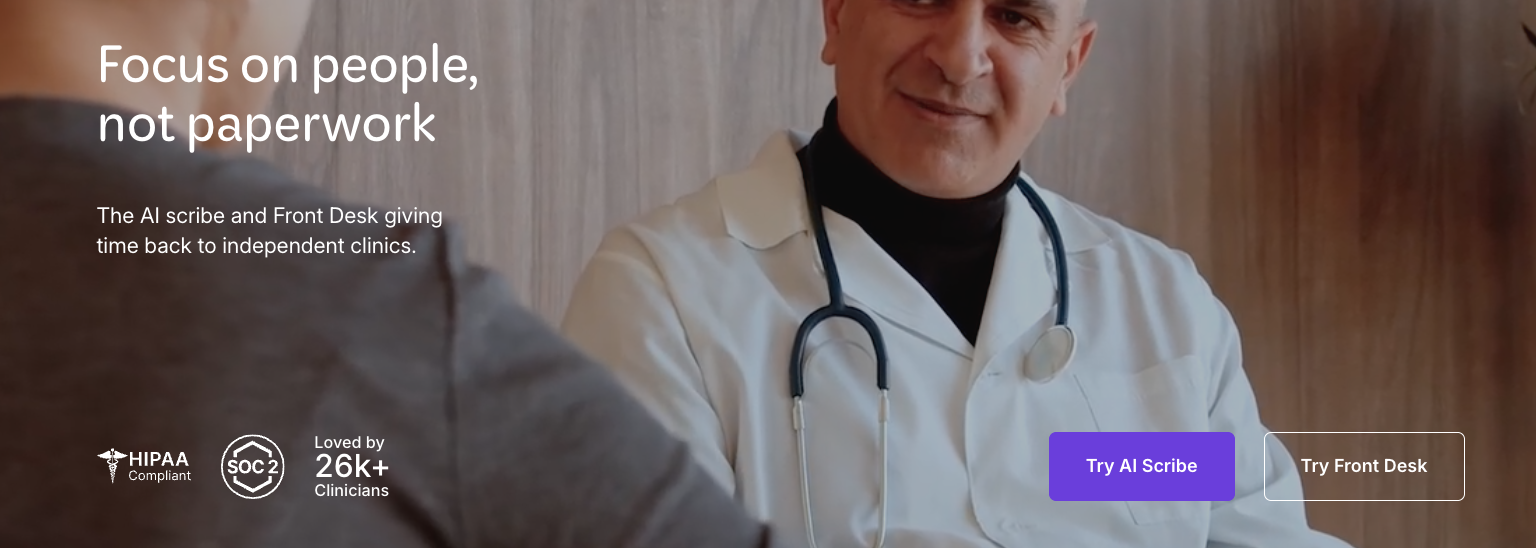
Freed gives you transparent pricing, self-serve setup, and notes that sound like US clinical practice, because they were built for it. It's also more than a note generator. Clinical Evidence lets you ask a clinical question in plain language and get an answer cited to 50+ trusted sources — PubMed, Cochrane, FDA, CDC, NIH, NEJM, and WHO — grounded in that patient's own visit, with no pharma ads or sponsored results mixed in.
The Coding Assistant suggests ICD-10, CPT, and E/M codes straight from the encounter and links them back to your documentation, which is where the accuracy and revenue gains actually come from.
And when you just need to add a line after the note is already generated, Dictate to Edit lets you speak it in with one click instead of typing. See the full feature list for everything included.
- Public pricing from $39/month (Starter) with a 7-day free trial and no credit card
- Works alongside any browser-based EHR through a Chrome extension, with no direct partnership required, plus one-click EHR push on Premier
- 50+ specialty templates, built by and for US clinicians, with a "Learn my Format" tool that adapts to each clinician's own documentation style over time
- Editable templates on every plan, no IT ticket required
- Clinical Evidence answers from 50+ trusted medical sources on Core and above
- ICD-10, CPT, and E/M coding support on Premier — in one practice's case study, the Coding Assistant was used on 99.5% of visits with an 83% code-acceptance rate
- Dictate to Edit for quick voice additions after your note is generated (Premier and Groups)
- A support team fluent in US billing and documentation norms
Pricing
- Starter — $39/month, up to 40 notes
- Core — $79/month, unlimited notes, instant template builder, and Clinical Evidence
- Premier — $104/month billed annually ($119 month-to-month), the full integration suite including EHR push, coding, and Dictate to Edit
- Groups — custom pricing
2. Abridge — Best for large health systems
Best for
Academic medical centers and large integrated health systems
Overview
Abridge won Best in KLAS for Ambient AI in 2025 and 2026, and Fast Company named it the most innovative healthcare company of 2025. It's built for high-volume enterprise deployment with system-level EHR integration, on enterprise contracts only, with no self-serve option.
See our full breakdown: Freed vs. Abridge.
Pricing
- Not published. Abridge has no pricing page and no self-serve signup
- Enterprise contracts only, negotiated per health system, typically annual
- Third-party analyses report roughly $200 to $300 per provider per month, with volume discounts at scale
- Usually provided at no individual cost when a health system deploys it
- No free trial or individual plan
3. Microsoft Dragon Copilot (formerly Nuance DAX) — Best for Epic-integrated enterprises
Best for
Epic-native health systems with enterprise budgets
Overview
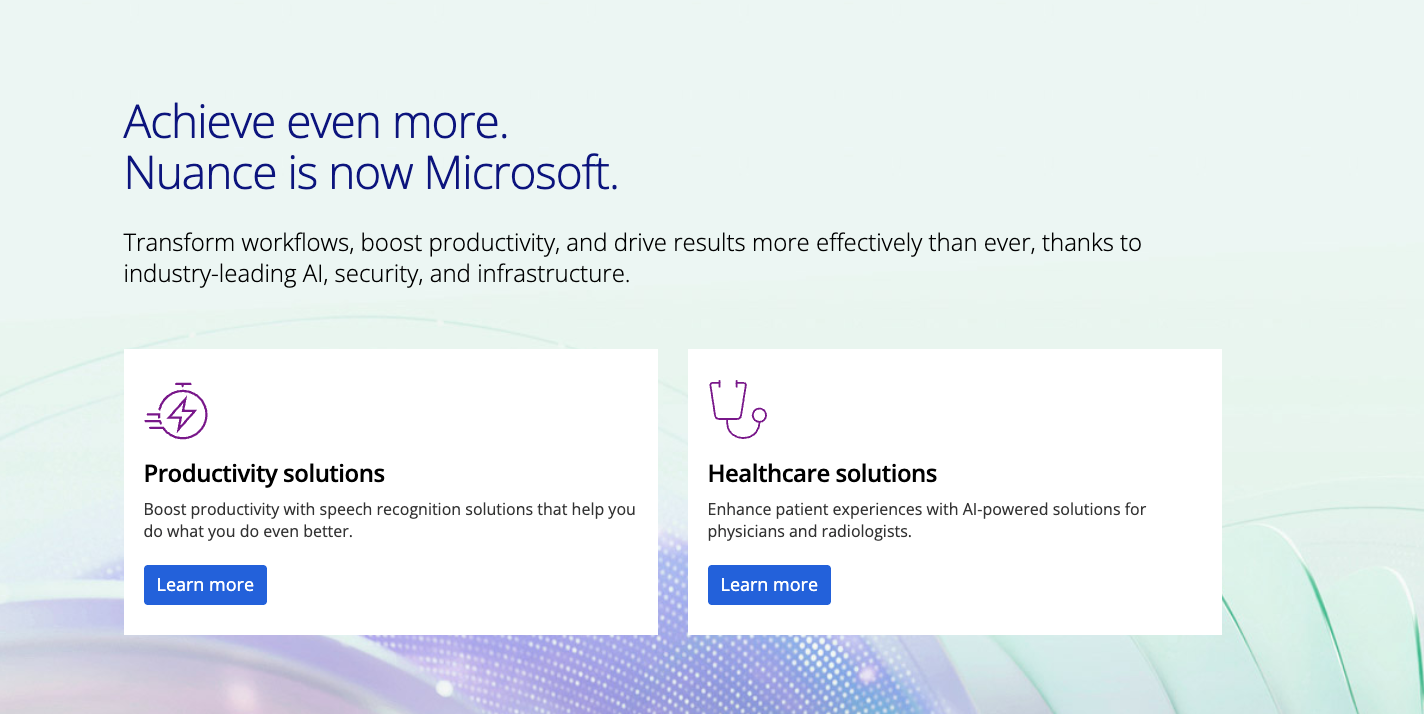
Microsoft folded Nuance DAX and Dragon Medical One into Dragon Copilot in 2025. It offers the deepest Epic embedding on the market. Microsoft doesn't publish per-provider pricing; third-party comparisons report roughly $400 to $600 per provider per month, which would make it the priciest option here.
See our full breakdown: Freed vs. Dragon Copilot.
Pricing
- Not published. Microsoft sells through enterprise agreements and volume licensing
- Third-party comparisons report roughly $400 to $600 per provider per month
- Estimates vary widely across sources, so treat any single figure as unverified. Expect the highest total cost in this category
- No free trial or self-serve option
4. Suki AI — Best for flexible deployments
Best for
Clinicians who want both ambient and dictation modes
Overview
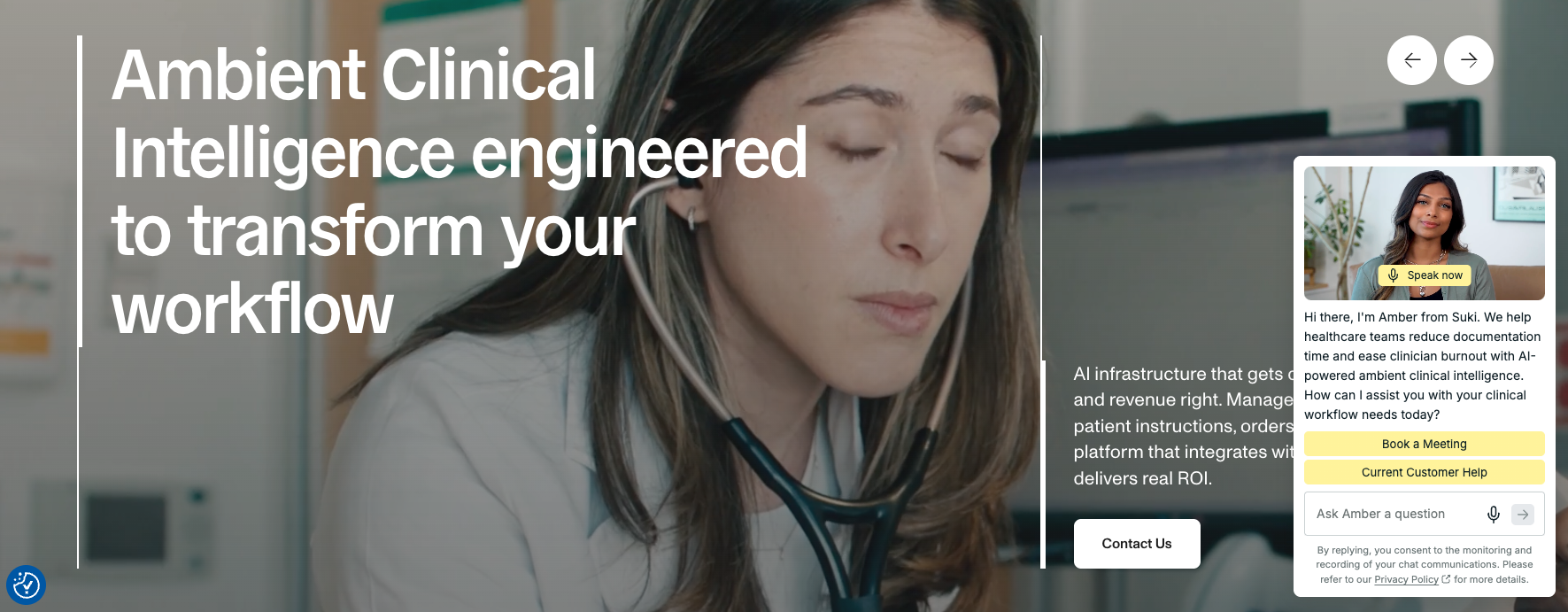
Suki is a voice-first clinical assistant that toggles between ambient documentation and traditional dictation, which makes it a fit for clinicians who don't want to give up dictating entirely. It integrates directly with Epic, athenahealth, Oracle Health, and MEDITECH, and markets support for 100+ specialties and 80 languages. Pricing isn't published and there's no self-serve signup, so evaluating Suki starts with a sales conversation.
See our full breakdown: Freed vs. Suki.
Pricing
- Not published. Suki has no pricing page; signup runs through their sales team
- Third-party comparisons report roughly $300 to $400 per provider per month
- Typically annual or enterprise contracts
- Demo-led rather than trial-led
5. Doximity Scribe — Best free option
Best for
Verified US clinicians who want a no-cost scribe
Overview
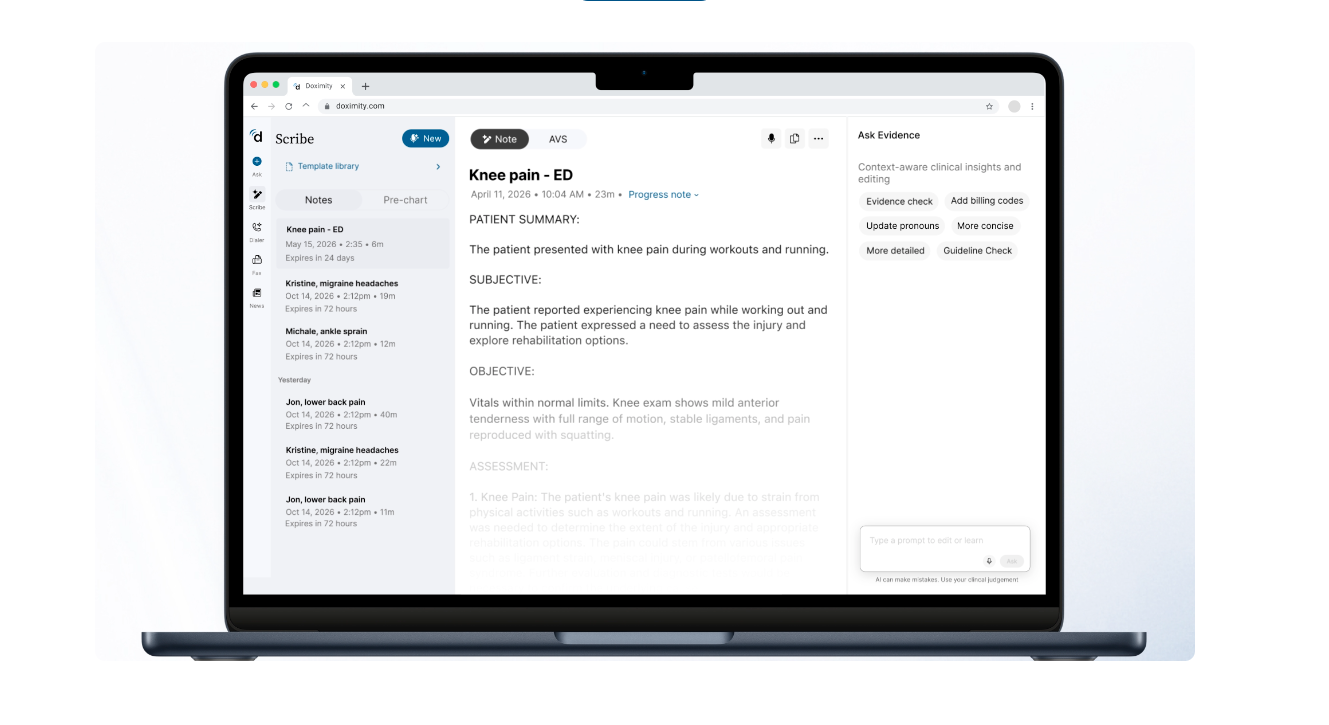
Doximity Scribe is free for verified US physicians, NPs, PAs, CRNAs, and students. No paid tier, no credit card. A solid entry point if you're not ready to commit to a subscription.
See the full comparison: Freed vs. Doximity.
Pricing
- Free for verified US physicians, NPs, PAs, CRNAs, and students
- No paid tier, no credit card, no upgrade path
- Requires a verified Doximity account
- Doximity sells a paid Clinical AI Suite to health systems, but Scribe itself stays free to individual clinicians
How an integrative medicine doctor cut two to three hours of nightly charting with a Nabla alternative
Dr. Nancy Lonsdorf, an integrative medicine physician with 38 years in practice, used to spend two to three hours every evening reconstructing detailed patient notes from memory and scribbled reminders.
Her new-patient visits run two to three hours and can produce up to 72 individualized recommendations across diet, supplements, and lifestyle.
The documentation load had gotten so heavy she'd started thinking about quitting. As a last resort, she sought AI tools for physicians that might lighten her load.
After trying other tools and finding them unable to keep up with the scope of her work, she found Freed. It now captures her full multi-hour consultations, organizes her sprawling recommendation lists automatically by category or condition, and surfaces patient history and lab context before each visit.
Her nightly charting sessions are gone, and her assistant, who used to help scribe, now focuses on higher-value work like managing supplement protocols. Her takeaway for other integrative medicine clinicians: the documentation burden in this specialty only grows, and no one should be carrying it alone.
Read the full case study here.
What switching saves you
Documentation eats hours you don't get back. Clinicians who move to a scribe that fits their practice report winning a meaningful share of that time back.
If you save an hour and a half a day, that's room for two or three more patients without extending your hours. What those visits are worth depends on your payer mix and visit types, so the honest advice is to run the math against your own average reimbursement rather than an industry benchmark.
Notes that sit open longer also take longer to bill, and practices using Freed have cut their note-closure time, with some closing notes in real time instead of days later. Faster closure means faster reimbursement.
None of this requires switching your entire tech stack or waiting on an IT department. Because Freed works through a browser-based Chrome extension rather than a deep EHR integration, you can start capturing that time back on day one of your free trial, not after a weeks-long implementation.
A Nabla evaluation usually looks different: a sales call to get pricing, a longer procurement conversation if you're not already an enterprise customer, and an implementation timeline built around health-system deployments rather than a single practice's Tuesday afternoon.
Explore more in our AI tools for physicians resource library.
How to choose the right Nabla alternative
- Choose Freed if: you're a solo, small-group, or mid-size multi-specialty practice that wants to start today, see the pricing upfront, and get notes that sound like US practice.
- Choose Abridge if: you're evaluating enterprise ambient AI with KLAS-validated outcomes and full procurement support.
- Choose Microsoft Dragon Copilot if: you're deep in the Epic ecosystem with an enterprise budget to match.
- Choose Nabla if: you need native Epic write-back, live in-visit transcription, or documentation across many languages.
- Choose Suki if: you want the option to switch between ambient and dictation.
- Choose Doximity Scribe if: you want free, no-commitment documentation support.
Find more detail in our guide to the best AI medical scribes.
Ready to try a Nabla alternative risk-free?
If you want transparent pricing, notes that sound like your practice, and a team that gets how US medicine works, Freed is the Nabla alternative to start with.
Try Freed free for 7 days and see the difference in your first patient visit.


Table of Contents
Nabla Copilot is a capable ambient AI scribe. It was built for health systems, though, and if you run an independent or small group practice in the US, that shows up in the pricing, the onboarding, and how much of the product you can reach without a sales call.
Below: why physicians switch, how the top AI medical scribes compare, and where Freed fits for US doctors who want to start today.
What is Nabla Copilot?
Nabla Copilot listens to your patient conversations and drafts clinical documentation in real time, with no manual transcription and no dictation. It belongs to the ambient AI category rather than the human-scribe one, a distinction we cover in our guide to AI scribe vs. human scribe.
It's built for scale: 85,000+ clinicians across 130+ health organizations, 55+ specialties, and direct integrations with Epic, athenahealth, Oracle Health, NextGen, Arya EHR, and Greenway.
What Nabla does well
- Direct EHR integrations across six major platforms, plus Nabla Connect for embedding in other EHR vendors
- Live transcription during the visit, which matters for MA workflows and multilingual encounters
- Note generation in roughly five seconds
- Broad multilingual support
- A randomized trial in NEJM AI covering 238 physicians at UCLA, reporting a roughly 10% reduction in note-writing time
- Enterprise rollout infrastructure and broad specialty coverage
- HIPAA-compliant architecture, with SOC 2 Type II and ISO 27001 certifications
Where it falls short for US practices
- No public pricing. You need a sales conversation just to know the cost
- Built for enterprise rollouts, not solo or small-group workflows
- Limited self-serve depth for individual clinicians
- Template customization is shallower for individual users than for enterprise accounts
Why physicians look for a Nabla alternative
Nabla isn't a bad product. It's built for a different buyer: a health system with a procurement process, not a solo internist or a two-physician family practice trying to cut clinical documentation time this week.
Pricing transparency
Third-party sources put Nabla's entry plan at around $119 per clinician per month, but Nabla doesn't publish pricing. You have to ask. Freed publishes all four of its plans, starting at $39/month. No call required.
US practices vs. health systems
Nabla was founded in Paris in 2018, and its flagship deployments are large: Kaiser Permanente, CVS Health, Children's Hospital LA, M Health Fairview. Those are real credentials, and they shape what gets built. Freed sells to independent US practices, so the roadmap answers to what a solo clinician or a five-provider clinic needs — US terminology, US coding, and onboarding that doesn't involve an IT department.
Template customization
Individual Nabla users often find deeper customization gated behind enterprise agreements. Every Freed plan, including the entry tier, gives you editable templates from your first note. No IT ticket needed.
Specialty breadth
Both Freed and Nabla's templates cover 50+ specialties. Freed's templates were built with US clinicians in each one, so the notes read closer to the way you'd write them.
Top Nabla alternatives in 2026
For the full field, see our guide to the best AI medical scribes.
1. Freed — Best overall for clinics across specialties
Best for
Solo practitioners, small-to-mid-size group practices, and multi-specialty clinics
Overview
Freed gives you transparent pricing, self-serve setup, and notes that sound like US clinical practice, because they were built for it. It's also more than a note generator. Clinical Evidence lets you ask a clinical question in plain language and get an answer cited to 50+ trusted sources — PubMed, Cochrane, FDA, CDC, NIH, NEJM, and WHO — grounded in that patient's own visit, with no pharma ads or sponsored results mixed in.
The Coding Assistant suggests ICD-10, CPT, and E/M codes straight from the encounter and links them back to your documentation, which is where the accuracy and revenue gains actually come from.
And when you just need to add a line after the note is already generated, Dictate to Edit lets you speak it in with one click instead of typing. See the full feature list for everything included.
- Public pricing from $39/month (Starter) with a 7-day free trial and no credit card
- Works alongside any browser-based EHR through a Chrome extension, with no direct partnership required, plus one-click EHR push on Premier
- 50+ specialty templates, built by and for US clinicians, with a "Learn my Format" tool that adapts to each clinician's own documentation style over time
- Editable templates on every plan, no IT ticket required
- Clinical Evidence answers from 50+ trusted medical sources on Core and above
- ICD-10, CPT, and E/M coding support on Premier — in one practice's case study, the Coding Assistant was used on 99.5% of visits with an 83% code-acceptance rate
- Dictate to Edit for quick voice additions after your note is generated (Premier and Groups)
- A support team fluent in US billing and documentation norms
Pricing
- Starter — $39/month, up to 40 notes
- Core — $79/month, unlimited notes, instant template builder, and Clinical Evidence
- Premier — $104/month billed annually ($119 month-to-month), the full integration suite including EHR push, coding, and Dictate to Edit
- Groups — custom pricing
2. Abridge — Best for large health systems
Best for
Academic medical centers and large integrated health systems
Overview
Abridge won Best in KLAS for Ambient AI in 2025 and 2026, and Fast Company named it the most innovative healthcare company of 2025. It's built for high-volume enterprise deployment with system-level EHR integration, on enterprise contracts only, with no self-serve option.
See our full breakdown: Freed vs. Abridge.
Pricing
- Not published. Abridge has no pricing page and no self-serve signup
- Enterprise contracts only, negotiated per health system, typically annual
- Third-party analyses report roughly $200 to $300 per provider per month, with volume discounts at scale
- Usually provided at no individual cost when a health system deploys it
- No free trial or individual plan
3. Microsoft Dragon Copilot (formerly Nuance DAX) — Best for Epic-integrated enterprises
Best for
Epic-native health systems with enterprise budgets
Overview
Microsoft folded Nuance DAX and Dragon Medical One into Dragon Copilot in 2025. It offers the deepest Epic embedding on the market. Microsoft doesn't publish per-provider pricing; third-party comparisons report roughly $400 to $600 per provider per month, which would make it the priciest option here.
See our full breakdown: Freed vs. Dragon Copilot.
Pricing
- Not published. Microsoft sells through enterprise agreements and volume licensing
- Third-party comparisons report roughly $400 to $600 per provider per month
- Estimates vary widely across sources, so treat any single figure as unverified. Expect the highest total cost in this category
- No free trial or self-serve option
4. Suki AI — Best for flexible deployments
Best for
Clinicians who want both ambient and dictation modes
Overview
Suki is a voice-first clinical assistant that toggles between ambient documentation and traditional dictation, which makes it a fit for clinicians who don't want to give up dictating entirely. It integrates directly with Epic, athenahealth, Oracle Health, and MEDITECH, and markets support for 100+ specialties and 80 languages. Pricing isn't published and there's no self-serve signup, so evaluating Suki starts with a sales conversation.
See our full breakdown: Freed vs. Suki.
Pricing
- Not published. Suki has no pricing page; signup runs through their sales team
- Third-party comparisons report roughly $300 to $400 per provider per month
- Typically annual or enterprise contracts
- Demo-led rather than trial-led
5. Doximity Scribe — Best free option
Best for
Verified US clinicians who want a no-cost scribe
Overview
Doximity Scribe is free for verified US physicians, NPs, PAs, CRNAs, and students. No paid tier, no credit card. A solid entry point if you're not ready to commit to a subscription.
See the full comparison: Freed vs. Doximity.
Pricing
- Free for verified US physicians, NPs, PAs, CRNAs, and students
- No paid tier, no credit card, no upgrade path
- Requires a verified Doximity account
- Doximity sells a paid Clinical AI Suite to health systems, but Scribe itself stays free to individual clinicians
How an integrative medicine doctor cut two to three hours of nightly charting with a Nabla alternative
Dr. Nancy Lonsdorf, an integrative medicine physician with 38 years in practice, used to spend two to three hours every evening reconstructing detailed patient notes from memory and scribbled reminders.
Her new-patient visits run two to three hours and can produce up to 72 individualized recommendations across diet, supplements, and lifestyle.
The documentation load had gotten so heavy she'd started thinking about quitting. As a last resort, she sought AI tools for physicians that might lighten her load.
After trying other tools and finding them unable to keep up with the scope of her work, she found Freed. It now captures her full multi-hour consultations, organizes her sprawling recommendation lists automatically by category or condition, and surfaces patient history and lab context before each visit.
Her nightly charting sessions are gone, and her assistant, who used to help scribe, now focuses on higher-value work like managing supplement protocols. Her takeaway for other integrative medicine clinicians: the documentation burden in this specialty only grows, and no one should be carrying it alone.
Read the full case study here.
What switching saves you
Documentation eats hours you don't get back. Clinicians who move to a scribe that fits their practice report winning a meaningful share of that time back.
If you save an hour and a half a day, that's room for two or three more patients without extending your hours. What those visits are worth depends on your payer mix and visit types, so the honest advice is to run the math against your own average reimbursement rather than an industry benchmark.
Notes that sit open longer also take longer to bill, and practices using Freed have cut their note-closure time, with some closing notes in real time instead of days later. Faster closure means faster reimbursement.
None of this requires switching your entire tech stack or waiting on an IT department. Because Freed works through a browser-based Chrome extension rather than a deep EHR integration, you can start capturing that time back on day one of your free trial, not after a weeks-long implementation.
A Nabla evaluation usually looks different: a sales call to get pricing, a longer procurement conversation if you're not already an enterprise customer, and an implementation timeline built around health-system deployments rather than a single practice's Tuesday afternoon.
Explore more in our AI tools for physicians resource library.
How to choose the right Nabla alternative
- Choose Freed if: you're a solo, small-group, or mid-size multi-specialty practice that wants to start today, see the pricing upfront, and get notes that sound like US practice.
- Choose Abridge if: you're evaluating enterprise ambient AI with KLAS-validated outcomes and full procurement support.
- Choose Microsoft Dragon Copilot if: you're deep in the Epic ecosystem with an enterprise budget to match.
- Choose Nabla if: you need native Epic write-back, live in-visit transcription, or documentation across many languages.
- Choose Suki if: you want the option to switch between ambient and dictation.
- Choose Doximity Scribe if: you want free, no-commitment documentation support.
Find more detail in our guide to the best AI medical scribes.
Ready to try a Nabla alternative risk-free?
If you want transparent pricing, notes that sound like your practice, and a team that gets how US medicine works, Freed is the Nabla alternative to start with.
Try Freed free for 7 days and see the difference in your first patient visit.
FAQs
Frequently asked questions from clinicians and medical practitioners.

Are AI scribes HIPAA compliant?

What is the best Nabla Copilot alternative for US physicians?
How does Freed's pricing compare to Nabla?
Does Freed integrate with Epic and other EHRs?
Can I try Freed before switching from Nabla?
What are the main limitations of Nabla Copilot?
Is Nabla HIPAA compliant?
Related content
Free yourself for better things


548 Market Street, PMB 95301
San Francisco, CA 94104
Specialties
Compliance & Security
Our technology is HIPAA-compliant, uses industry best practices, and doesn’t store patient recordings.