Best Medical Answering Services of 2026 Ranked
Your patients don't stop needing care when your office closes. Missed calls mean missed appointments, frustrated patients, and revenue that walks out the door.
Patients hate playing phone tag. A medical answering service is supposed to fix that. But not all of them are built for healthcare, and not all of them are worth what they charge. This guide ranks the best medical answering services of 2026 based on:
- HIPAA compliance
- After-hours coverage
- Call routing and triage capabilities
- EHR integrations
- Pricing model
- Scalability
- Overall patient experience
Whether you're a solo practitioner or a multi-site group, we'll find the right tool for how you actually practice.
See how Freed's AI Front Desk handles patient calls 24/7 — Start free trial
What is a medical answering service?
A medical answering service handles inbound patient calls when your office is closed, your front desk is busy, or your call volume exceeds what staff can manage. Depending on the service, calls are handled by live operators, AI voice agents, or a combination of both.
Historically, medical answering services relied on live medical receptionists who answered calls and routed urgent issues to on-call providers. Today, many healthcare organizations are adopting AI-powered medical answering services to automatically complete those tasks. Common use cases include:
- After-hours calls: urgent questions, triage, and on-call routing outside business hours
- Overflow handling: capturing calls that would otherwise go to voicemail during peak hours
- Appointment scheduling: booking, rescheduling, and cancellation requests
- Prescription refill requests: triaging and routing to the appropriate provider
- Urgent escalation: identifying true emergencies and reaching on-call clinicians
The key distinction between a medical answering service and a generic call center is HIPAA compliance. Any service that touches protected health information (PHI) must operate under a signed Business Associate Agreement (BAA). Without one, your practice is exposed.
What to look for in a medical answering service
HIPAA compliance and BAA availability
This is the table-stakes filter. If a service handles PHI — patient names, symptoms, medications, appointment details — they must sign a BAA. Many generic answering services do not offer this. Before evaluating anything else, confirm BAA availability and ask whether the service is HIPAA, HITECH, and SOC 2 certified.
After-hours and 24/7 coverage
Around 40% of patient calls come after office hours. If your answering service doesn't cover nights, weekends, and holidays, you're leaving a significant portion of your patient communication unmanaged. Look for true 24/7 availability, not just extended hours.
Call routing and triage protocols
Not every call is an emergency, and not every call is routine. Your answering service needs to know the difference. Look for customizable triage protocols that escalate urgent calls to on-call providers while handling routine requests through automated workflows.
Message delivery
The best services don't create additional data-entry work. Many support EHR integration or reliable message delivery like secure texts, emails, or portal messages. Your team can act on after-hours communication without manual transcription.
AI-powered vs. live operator services
Live operator services have been the industry standard for decades. AI-powered services are newer, faster, and dramatically cheaper, and they've reached a level of sophistication where they can handle the majority of patient call types without human involvement. The right choice depends on your call complexity and budget. Key differences include:
Best medical answering services of 2026
1. Freed Front Desk — Best for AI-native, 24/7 automation
Best for
Practices that want to eliminate per-minute billing and automate the full after-hours experience without managing scripts or staffing.
Overview
Freed's Front Desk is the only option on this list built from the ground up as a healthcare AI product. Where traditional answering services bolt HIPAA compliance onto a generic call center infrastructure, Freed was designed with clinical workflows at its core.
Rather than relying on live operators, the platform uses AI voice agents trained on your practice workflows. The AI answers calls 24/7, handles appointment scheduling, routes urgent calls to on-call providers, supports two-way SMS messaging, and delivers structured summaries to your team — all on a flat monthly subscription. There's no script to write and no QA team to manage. The system learns from your practice's website and custom rules during setup.
Key features
- 24/7 AI voice answering with zero incremental cost for after-hours volume
- HIPAA-compliant with BAA available — meets HIPAA, HITECH, and SOC 2 Type 2 standards
- Customizable triage protocols by call type and urgency
- Faster patient access due to smart routing
- No patient recordings retained after call processing; audio is deleted automatically
- Patient data never used for AI training
- Fewer missed calls for your practice
- Predictable, volume-based pricing
HIPAA status
Fully compliant. BAA in use with hundreds of health systems across Freed products. SOC 2 Type 2 certified.
Pricing
$149 per block of 250 calls.
Why Freed Front Desk stands out
Traditional answering services often charge $1–$2 per minute. AI solutions can reduce answering service costs by 6–8x while providing faster response times and unlimited scalability.
Specialties
Primary care, behavioral health, family medicine, internal medicine, OB-GYN, and any specialty that handles high after-hours call volume without wanting to pay large premiums.
Learn more about Freed Front Desk AI →
2. MAP Communications — Best for live-agent coverage
Best for
Practices that require a human voice on every call and have the budget for premium per-minute rates.
Overview
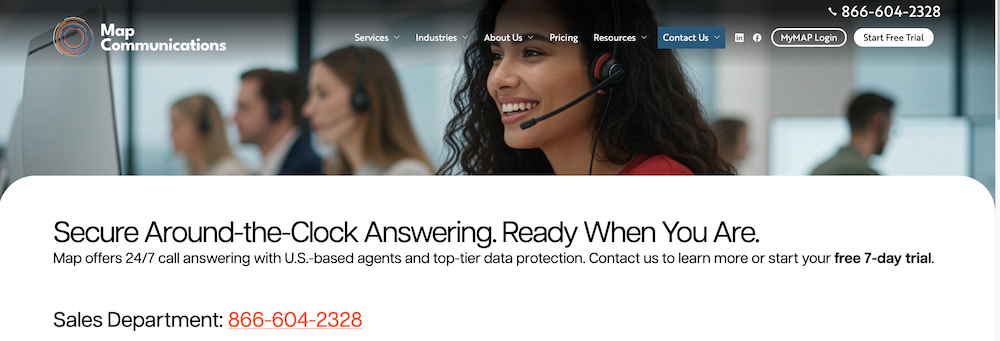
MAP Communications has been in the medical answering space for decades and offers 24/7 live operator coverage. Agents are trained on HIPAA protocols and the company offers BAA agreements for medical clients. Calls are handled by U.S.-based operators, and the service includes customizable scripts, on-call scheduling, and urgent escalation.
Key features:
- 24/7 U.S.-based live operators
- HIPAA-compliant with BAA availability
- Custom call scripts and escalation protocols
- On-call scheduling management
HIPAA status
HIPAA-compliant with BAA available.
Pricing
Per-minute billing model; rates typically range from $1.00–$2.00/minute depending on call volume and plan tier. Monthly minimums may apply.
3. AnswerConnect — Best for high-volume overflow handling

Best for
Busy practices that need reliable overflow coverage during business hours without replacing their front desk entirely.
Overview
AnswerConnect offers 24/7 live agent coverage with a strong focus on overflow call management. Medical practices can use AnswerConnect to catch calls that would otherwise go to voicemail during peak hours. The service includes message delivery via email, text, and app, along with customizable call handling instructions.
Key features
- 24/7 live agent answering
- Overflow and after-hours coverage
- Message delivery by text, email, or app
- Basic appointment scheduling support
HIPAA status
HIPAA-compliant plans available with BAA upon request. Confirm directly before signing.
Pricing
Per-minute billing; monthly plans typically start around $149–$300/month for low-volume practices, with costs scaling significantly as call volume grows.
4. Nexa — Best for emergency dispatch, hybrid + AI service
Best for
Practices that want AI efficiency for routine calls but live escalation for complex situations.
Overview
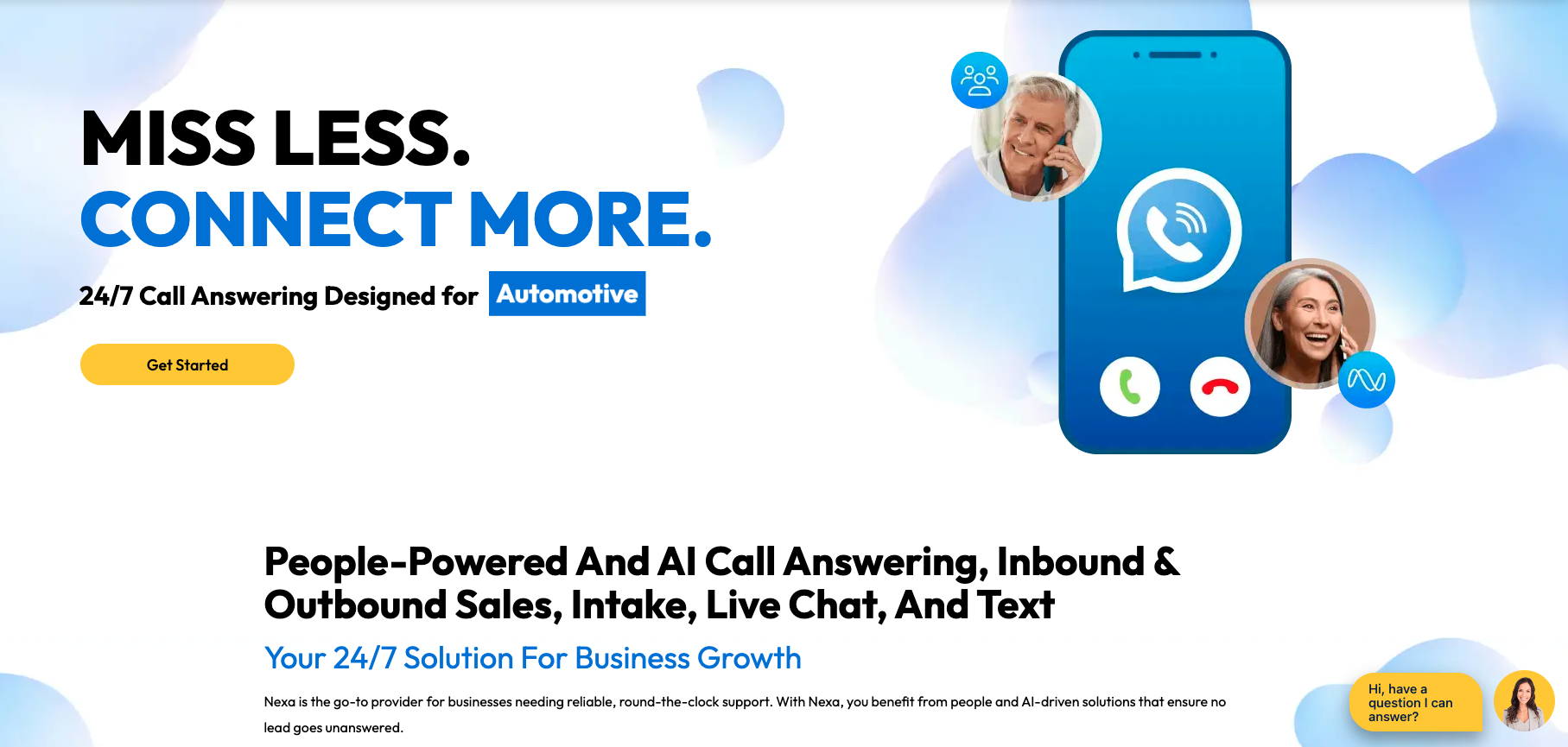
Nexa Healthcare offers a hybrid model that routes calls through AI triage first, then escalates to live agents when needed. This approach reduces per-minute costs while preserving a human fallback for urgent or complex calls. EHR integration and appointment scheduling are available.
Key features
- AI-first routing with live agent escalation
- 24/7 availability
- EHR integration and appointment scheduling
- HIPAA-compliant with BAA
HIPAA status
HIPAA-compliant with BAA available.
Pricing
Pricing packages are based on minutes of usage. Contact for current rates.
5. Physicians Answering Service (PAS) — Best for specialty-specific call handling

Best for
Specialty practices (cardiology, oncology, high-risk OB, etc.) that need operators trained in specialty-specific triage language.
Overview
Physicians Answering Service focuses exclusively on healthcare clients, which means their operators have medical vocabulary and understand the difference between a chest pain call and a refill request. The service is built around specialty-specific protocols and on-call physician routing.
Key features
- Healthcare-exclusive operator training
- Specialty-specific triage scripts
- On-call physician notification and escalation
- Secure message delivery
HIPAA status
Healthcare-focused with HIPAA compliance and BAA available.
Pricing
Offers a two-week free trial. A variety of packages with per-minute billing; rates vary by specialty and call complexity. Contact for a quote.
6. Ruby Virtual Receptionists — Best for small practices wanting a personal touch

Best for
Small practices like solo providers or two- to three-clinician groups where a warm, branded experience matters more than scale or cost-efficiency.
Overview
Ruby is a live receptionist service built around personality and patient experience. Receptionists are trained to represent your practice in a consistent, friendly way. HIPAA-compliant plans are available. Ruby does not specialize in clinical triage. It’s better suited for scheduling, general inquiries, and first-contact experience.
Key features
- Live receptionist with personalized call handling
- HIPAA plans with BAA available
- Bilingual support (English/Spanish)
- Mobile app for call management and message delivery
HIPAA status
HIPAA-compliant plans available with BAA — confirm at signup.
Pricing
Monthly flat-rate plans starting around $235–$500/month for low call volumes. Per-minute overages apply beyond plan minutes.
Medical answering service pricing: What to expect in 2026
Medical office answering service pricing breaks into three models:
Per-minute billing
This is the traditional model for live operator services. Rates typically range from $1.00–$2.00 per minute, with monthly minimums between $50–$150. Practices with high after-hours volume can see monthly bills of $400–$1,500 or more. Weekend and overnight rates often carry a surcharge.
Flat-rate plans
These are cvommon among live receptionist services like Ruby. They bundle a set number of minutes into a monthly fee, with per-minute overages for anything beyond the limit. Monthly plans for small practices typically range from $235–$500/month at low volumes.
AI subscription pricing
Virtual medical receptionists often replace traditional billing with predictable, volume-based pricing. This dramatically reduces cost for practices with high after-hours call loads. For many mid-size practices, the effective cost per call handled by AI is a fraction of what live operators charge.
For a practice receiving 300 after-hours calls per month averaging four minutes each — that's 1,200 minutes. At $1.50/minute, that's $1,800/month for live operator coverage. A flat-rate AI service handling the same volume costs a fraction of that, with no weekend surcharges.
Choosing an answering service
If you're still paying too muchfor after-hours coverage, you're paying a 2010-era price for a problem that has a 2026 solution. AI-native services like Freed's AI Front Desk handle the same call types at a fraction of the cost, with no staffing risk, no script management, and built-in HIPAA compliance.
Get deserve an answering service that does it all. Try Freed Front Desk free


Table of Contents
Your patients don't stop needing care when your office closes. Missed calls mean missed appointments, frustrated patients, and revenue that walks out the door.
Patients hate playing phone tag. A medical answering service is supposed to fix that. But not all of them are built for healthcare, and not all of them are worth what they charge. This guide ranks the best medical answering services of 2026 based on:
- HIPAA compliance
- After-hours coverage
- Call routing and triage capabilities
- EHR integrations
- Pricing model
- Scalability
- Overall patient experience
Whether you're a solo practitioner or a multi-site group, we'll find the right tool for how you actually practice.
See how Freed's AI Front Desk handles patient calls 24/7 — Start free trial
What is a medical answering service?
A medical answering service handles inbound patient calls when your office is closed, your front desk is busy, or your call volume exceeds what staff can manage. Depending on the service, calls are handled by live operators, AI voice agents, or a combination of both.
Historically, medical answering services relied on live medical receptionists who answered calls and routed urgent issues to on-call providers. Today, many healthcare organizations are adopting AI-powered medical answering services to automatically complete those tasks. Common use cases include:
- After-hours calls: urgent questions, triage, and on-call routing outside business hours
- Overflow handling: capturing calls that would otherwise go to voicemail during peak hours
- Appointment scheduling: booking, rescheduling, and cancellation requests
- Prescription refill requests: triaging and routing to the appropriate provider
- Urgent escalation: identifying true emergencies and reaching on-call clinicians
The key distinction between a medical answering service and a generic call center is HIPAA compliance. Any service that touches protected health information (PHI) must operate under a signed Business Associate Agreement (BAA). Without one, your practice is exposed.
What to look for in a medical answering service
HIPAA compliance and BAA availability
This is the table-stakes filter. If a service handles PHI — patient names, symptoms, medications, appointment details — they must sign a BAA. Many generic answering services do not offer this. Before evaluating anything else, confirm BAA availability and ask whether the service is HIPAA, HITECH, and SOC 2 certified.
After-hours and 24/7 coverage
Around 40% of patient calls come after office hours. If your answering service doesn't cover nights, weekends, and holidays, you're leaving a significant portion of your patient communication unmanaged. Look for true 24/7 availability, not just extended hours.
Call routing and triage protocols
Not every call is an emergency, and not every call is routine. Your answering service needs to know the difference. Look for customizable triage protocols that escalate urgent calls to on-call providers while handling routine requests through automated workflows.
Message delivery
The best services don't create additional data-entry work. Many support EHR integration or reliable message delivery like secure texts, emails, or portal messages. Your team can act on after-hours communication without manual transcription.
AI-powered vs. live operator services
Live operator services have been the industry standard for decades. AI-powered services are newer, faster, and dramatically cheaper, and they've reached a level of sophistication where they can handle the majority of patient call types without human involvement. The right choice depends on your call complexity and budget. Key differences include:
Best medical answering services of 2026
1. Freed Front Desk — Best for AI-native, 24/7 automation
Best for
Practices that want to eliminate per-minute billing and automate the full after-hours experience without managing scripts or staffing.
Overview
Freed's Front Desk is the only option on this list built from the ground up as a healthcare AI product. Where traditional answering services bolt HIPAA compliance onto a generic call center infrastructure, Freed was designed with clinical workflows at its core.
Rather than relying on live operators, the platform uses AI voice agents trained on your practice workflows. The AI answers calls 24/7, handles appointment scheduling, routes urgent calls to on-call providers, supports two-way SMS messaging, and delivers structured summaries to your team — all on a flat monthly subscription. There's no script to write and no QA team to manage. The system learns from your practice's website and custom rules during setup.
Key features
- 24/7 AI voice answering with zero incremental cost for after-hours volume
- HIPAA-compliant with BAA available — meets HIPAA, HITECH, and SOC 2 Type 2 standards
- Customizable triage protocols by call type and urgency
- Faster patient access due to smart routing
- No patient recordings retained after call processing; audio is deleted automatically
- Patient data never used for AI training
- Fewer missed calls for your practice
- Predictable, volume-based pricing
HIPAA status
Fully compliant. BAA in use with hundreds of health systems across Freed products. SOC 2 Type 2 certified.
Pricing
$149 per block of 250 calls.
Why Freed Front Desk stands out
Traditional answering services often charge $1–$2 per minute. AI solutions can reduce answering service costs by 6–8x while providing faster response times and unlimited scalability.
Specialties
Primary care, behavioral health, family medicine, internal medicine, OB-GYN, and any specialty that handles high after-hours call volume without wanting to pay large premiums.
Learn more about Freed Front Desk AI →
2. MAP Communications — Best for live-agent coverage
Best for
Practices that require a human voice on every call and have the budget for premium per-minute rates.
Overview
MAP Communications has been in the medical answering space for decades and offers 24/7 live operator coverage. Agents are trained on HIPAA protocols and the company offers BAA agreements for medical clients. Calls are handled by U.S.-based operators, and the service includes customizable scripts, on-call scheduling, and urgent escalation.
Key features:
- 24/7 U.S.-based live operators
- HIPAA-compliant with BAA availability
- Custom call scripts and escalation protocols
- On-call scheduling management
HIPAA status
HIPAA-compliant with BAA available.
Pricing
Per-minute billing model; rates typically range from $1.00–$2.00/minute depending on call volume and plan tier. Monthly minimums may apply.
3. AnswerConnect — Best for high-volume overflow handling
Best for
Busy practices that need reliable overflow coverage during business hours without replacing their front desk entirely.
Overview
AnswerConnect offers 24/7 live agent coverage with a strong focus on overflow call management. Medical practices can use AnswerConnect to catch calls that would otherwise go to voicemail during peak hours. The service includes message delivery via email, text, and app, along with customizable call handling instructions.
Key features
- 24/7 live agent answering
- Overflow and after-hours coverage
- Message delivery by text, email, or app
- Basic appointment scheduling support
HIPAA status
HIPAA-compliant plans available with BAA upon request. Confirm directly before signing.
Pricing
Per-minute billing; monthly plans typically start around $149–$300/month for low-volume practices, with costs scaling significantly as call volume grows.
4. Nexa — Best for emergency dispatch, hybrid + AI service
Best for
Practices that want AI efficiency for routine calls but live escalation for complex situations.
Overview
Nexa Healthcare offers a hybrid model that routes calls through AI triage first, then escalates to live agents when needed. This approach reduces per-minute costs while preserving a human fallback for urgent or complex calls. EHR integration and appointment scheduling are available.
Key features
- AI-first routing with live agent escalation
- 24/7 availability
- EHR integration and appointment scheduling
- HIPAA-compliant with BAA
HIPAA status
HIPAA-compliant with BAA available.
Pricing
Pricing packages are based on minutes of usage. Contact for current rates.
5. Physicians Answering Service (PAS) — Best for specialty-specific call handling
Best for
Specialty practices (cardiology, oncology, high-risk OB, etc.) that need operators trained in specialty-specific triage language.
Overview
Physicians Answering Service focuses exclusively on healthcare clients, which means their operators have medical vocabulary and understand the difference between a chest pain call and a refill request. The service is built around specialty-specific protocols and on-call physician routing.
Key features
- Healthcare-exclusive operator training
- Specialty-specific triage scripts
- On-call physician notification and escalation
- Secure message delivery
HIPAA status
Healthcare-focused with HIPAA compliance and BAA available.
Pricing
Offers a two-week free trial. A variety of packages with per-minute billing; rates vary by specialty and call complexity. Contact for a quote.
6. Ruby Virtual Receptionists — Best for small practices wanting a personal touch
Best for
Small practices like solo providers or two- to three-clinician groups where a warm, branded experience matters more than scale or cost-efficiency.
Overview
Ruby is a live receptionist service built around personality and patient experience. Receptionists are trained to represent your practice in a consistent, friendly way. HIPAA-compliant plans are available. Ruby does not specialize in clinical triage. It’s better suited for scheduling, general inquiries, and first-contact experience.
Key features
- Live receptionist with personalized call handling
- HIPAA plans with BAA available
- Bilingual support (English/Spanish)
- Mobile app for call management and message delivery
HIPAA status
HIPAA-compliant plans available with BAA — confirm at signup.
Pricing
Monthly flat-rate plans starting around $235–$500/month for low call volumes. Per-minute overages apply beyond plan minutes.
Medical answering service pricing: What to expect in 2026
Medical office answering service pricing breaks into three models:
Per-minute billing
This is the traditional model for live operator services. Rates typically range from $1.00–$2.00 per minute, with monthly minimums between $50–$150. Practices with high after-hours volume can see monthly bills of $400–$1,500 or more. Weekend and overnight rates often carry a surcharge.
Flat-rate plans
These are cvommon among live receptionist services like Ruby. They bundle a set number of minutes into a monthly fee, with per-minute overages for anything beyond the limit. Monthly plans for small practices typically range from $235–$500/month at low volumes.
AI subscription pricing
Virtual medical receptionists often replace traditional billing with predictable, volume-based pricing. This dramatically reduces cost for practices with high after-hours call loads. For many mid-size practices, the effective cost per call handled by AI is a fraction of what live operators charge.
For a practice receiving 300 after-hours calls per month averaging four minutes each — that's 1,200 minutes. At $1.50/minute, that's $1,800/month for live operator coverage. A flat-rate AI service handling the same volume costs a fraction of that, with no weekend surcharges.
Choosing an answering service
If you're still paying too muchfor after-hours coverage, you're paying a 2010-era price for a problem that has a 2026 solution. AI-native services like Freed's AI Front Desk handle the same call types at a fraction of the cost, with no staffing risk, no script management, and built-in HIPAA compliance.
Get deserve an answering service that does it all. Try Freed Front Desk free
FAQs
Frequently asked questions from clinicians and medical practitioners.

Are medical answering services HIPAA compliant?

How much does a medical answering service cost?
What is the difference between an answering service and an AI front desk?
Can an AI handle after-hours patient calls?
What is the best medical answering service?
Related content
Free yourself for better things


548 Market Street, PMB 95301
San Francisco, CA 94104
Specialties
Compliance & Security
Our technology is HIPAA-compliant, uses industry best practices, and doesn’t store patient recordings.