
Table of Contents
There's always another question. A tapering schedule. A screening tool you interpret twice a year. A guideline that moved since you last checked.
Most of the time you go looking for the answer outside the note. A browser tab, a separate app, a quick ChatGPT query. Patient context moves out of the HIPAA boundary, and you lose the thread of the visit trying to find it again.
Freed keeps the question where the work already is.
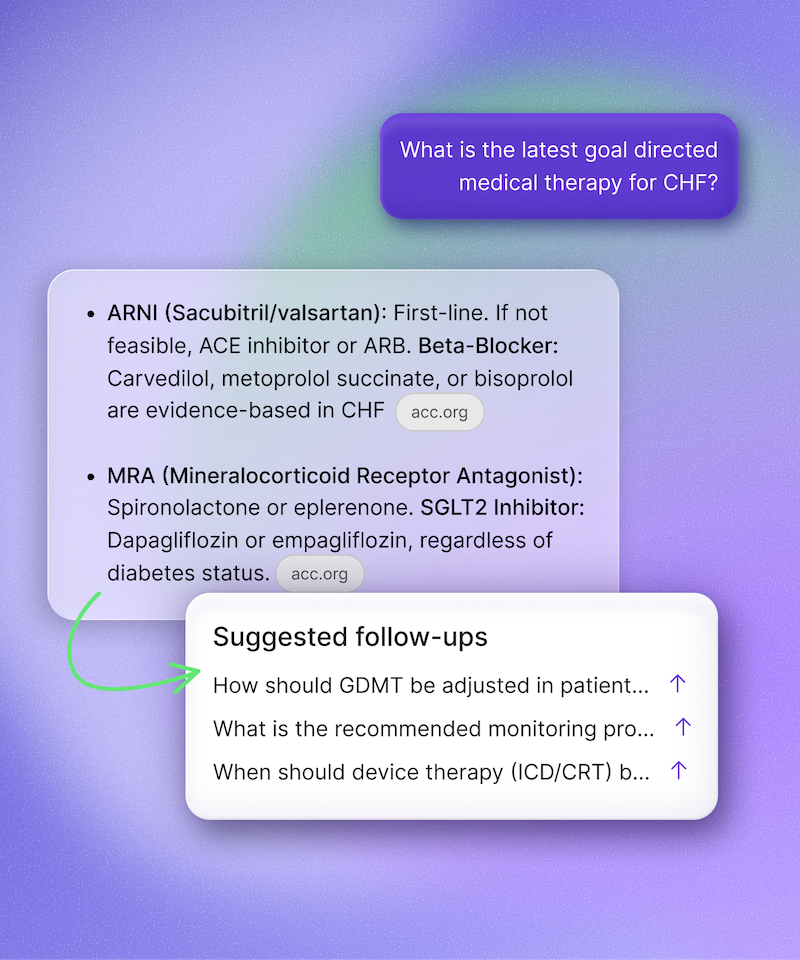
One AI Chat panel, three kinds of asks
AI Chat is the panel on the right side of every visit in Freed. It's always open, it already understands the patient and the note in front of it, and it takes plain language. There's no syntax to learn.
Clinicians use it three ways.
- Ask a clinical question. "What's the recommended venlafaxine tapering regimen for this patient?" You get Clinical Evidence: an answer drawn from 50+ trusted medical sources, with linked citations you can open and read. This is the one clinicians reach for most, and the rest of this post is about it.
- Tell it to change the note. "Separate the Assessment and Plan by diagnosis." "Tighten the HPI." "Change every instance of patient to client." AI Chat edits the note you're already looking at. You can dictate the change instead of typing it.
- Ask for help using Freed. "How do I build a template for annual physicals?" "Why didn't this note push to my EHR?" Same box, no ticket, no leaving the visit.
What Clinical Evidence is
Ask a clinical question in AI Chat and Freed answers from a curated library of more than 50 trusted medical sources, including PubMed, federal clinical guidance, specialty society guidelines, and leading peer-reviewed journals. Every answer links to its sources, so you can check the basis for yourself.
The answer is shaped by the patient in front of you. Freed already has the visit and the note, so a pediatrician asking about weight-based dosing gets an answer that accounts for this patient's weight. A psychiatrist asking about a taper gets an answer shaped by what's already documented. You're not starting from a blank search box.
Freed surfaces the evidence. The judgment, and every decision that follows, is yours.
How it works
- Ask in plain language. Open the AI Chat panel and type the question the way you'd ask a colleague down the hall. Freed comes back with a cited answer, usually in well under a minute.
- Grounded in this patient. A standalone reference tool starts cold. Clinical Evidence reads from the visit: history, medications mentioned, what came up today. Anything you add later contributes to the next answer.
- A library governed by clinicians. Answers come only from Freed's whitelist of vetted sources. No open web, no ads, no sponsored placement. Practicing clinicians decide which sources are in scope and continuously evaluate the answers that come back.
- PHI stays inside Freed. Freed removes patient-identifying information before any external query. PHI never leaves Freed's HIPAA-compliant environment.
Clinical Evidence vs. other reference tools
Many clinicians reach for Open Evidence, UpToDate, or a general-purpose AI tool like ChatGPT when a question comes up.
Your clinical thinking, in one place
Freed brings cited answers into the same panel where you document, code, and close out the visit. One place to ask, one place to work.
The evidence is for us to surface. The call is yours.
AI Chat with Clinical Evidence is included in every Freed plan at no additional cost.
FAQs
Frequently asked questions from clinicians and medical practitioners.

What is Freed's Clinical Evidence?

How do I start using Freed's clinical decision support?
What else can AI Chat do?
Is Clinical Evidence HIPAA compliant?
Does Clinical Evidence replace clinical judgment?



548 Market Street, PMB 95301
San Francisco, CA 94104
Specialties
Compliance & Security
Our technology is HIPAA-compliant, uses industry best practices, and doesn’t store patient recordings.