6 Best Medical Coding Software of 2026: Ranked for Accuracy, Speed & Compliance
Medical coding errors are expensive. Industry data consistently shows claim denial rates of 5–10%, and even a modest improvement in coding accuracy can recover thousands of dollars annually for a busy practice.
Whether you're a billing manager comparing platforms or a practice owner trying to tighten revenue cycle management, the right medical coding software is one of the highest-leverage investments you can make.
This guide breaks down the best medical coding software available in 2026, with a clear-eyed look at:
- Accuracy
- EHR integration
- HIPAA compliance
- Pricing
So you can make a confident decision without wading through vendor marketing.
What is medical coding software?
Medical coding software converts clinical documentation lik physician notes, encounter records, and procedure descriptions into standardized codes used for billing and reimbursement.
These include ICD-10 codes (diagnoses), CPT codes (procedures), and HCPCS codes (supplies and services billed to Medicare and Medicaid).
Accurate coding determines how quickly and how much a practice gets paid. Undercoding leaves revenue on the table. Overcoding invites audits. The goal is precision: codes that accurately reflect the care provided.
Rule-based vs. AI-native coding engines
Traditional medical coding software uses rule-based logic — essentially lookup tables and keyword matching — to suggest codes based on terms found in documentation. These tools are structured, predictable, and familiar to many billing departments, but they require clean, standardized input and can miss nuanced clinical language.
AI-native coding engines read clinical documentation the way a trained coder would. They interpret context, recognize clinical concepts regardless of how they're phrased, and learn from corrections over time. This makes them faster and more accurate for real-world notes, which are rarely perfectly structured.
How to choose medical coding software
AI-powered vs. rule-based coding
The right choice depends on your documentation environment.
If your practice generates structured, templated notes, rule-based systems can work adequately. If your clinicians dictate freeform notes — or use an AI scribe — an AI-native coding engine will perform significantly better, since it reads clinical language rather than searching for keywords.
ICD-10 and CPT code accuracy rates
Ask vendors for validated accuracy data, not just marketing claims. Specifically: what is the first-pass acceptance rate on code suggestions? What is the post-review denial rate? The best tools provide transparent benchmarking across specialties.
Look for vendors that can demonstrate:
- Coding validation workflows
- Audit capabilities
- Quality assurance processes
- Human review mechanisms
EHR integration and workflow fit
Code suggestions that require copy-pasting from one system to another slow coders down and introduce errors. Look for software that integrates directly with your existing EHR, pushes codes into the right fields, and fits naturally into the workflow your team already uses.
The fewer systems staff must switch between, the greater the efficiency gains.
HIPAA compliance and audit trail
Every tool handling protected health information (PHI) must be HIPAA-compliant and willing to sign a Business Associate Agreement (BAA). Beyond the BAA, look for SOC 2 Type 2 certification, end-to-end encryption, and clear data retention policies. The audit trail matters too — you need to be able to show, if reviewed, exactly what was coded and when. Compliance requirements become even more important when AI is involved.
Pricing model (per-claim vs. subscription)
Medical coding software pricing typically falls into one of three categories:
- Subscription pricing
- Per-user licensing
- Per-claim pricing
Per-claim pricing is intuitive but can become expensive as volume grows. Subscription pricing is more predictable for high-volume practices and billing companies. Evaluate all models against your actual claim volume.
Best medical coding software of 2026
1. Freed Coding Assistant (Best AI-native coding for independent practices)
Overview
Freed is best known as an AI medical scribe. It listens to patient encounters and generates clinical notes automatically, eliminating hours of documentation burden. Freed's Coding Assistant extends this intelligence: after a note is generated, Freed reads the documentation and suggests appropriate ICD-10 and CPT codes inline, without requiring any separate workflow.
For practices already using Freed for documentation, coding becomes a natural extension rather than a separate process. There's no copy-paste, no context-switching, and no need to re-read the note in a different system. The AI has already captured and understood the encounter; code suggestions follow directly from that.
Key features
- Post-visit coding suggestions
- Automatic, accurate, ICD-10 and CPT codes at the highest justified E/M level
- Analysis of clinic-wide billing trends to improve coding choices in future visits
- Coding impact dashboard
- AI chat functionality for increased code recommendations
- Works with existing EHR through Chrome extension or direct integration
Best for
Independent practices, small-to-mid-size groups (2–50 clinicians), and billing companies managing multiple client practices who want AI coding as part of a broader documentation workflow.
Pricing
Freed's Premier plan is 104/month. Group and enterprise pricing available with volume discounts.
See Freed's Coding Assistant in action — watch how it auto-suggests codes from your documentation. Book a demo →
2. Solventum 360 Encompass (Best for large hospital systems)
Overview
3M 360 Encompass is one of the most established computer-assisted coding (CAC) platforms in the market, built primarily for inpatient coding in large health systems. It uses natural language processing to read clinical documentation and suggest ICD-10-CM/PCS codes for inpatient encounters.
Key features
- Deep NLP engine trained on large inpatient datasets
- Tight integration with Epic and other enterprise EHRs
- Robust audit and compliance reporting
- Physician query workflow built in
Best for
Large hospitals and health systems with dedicated inpatient coding departments.
Pricing
Enterprise licensing; custom quotes. Generally priced for organizations with high inpatient volume.
Notable limitation
Overkill and cost-prohibitive for independent or outpatient-focused practices. Implementation requires IT resources.
3. Optum360 (Best for revenue cycle management firms)
Overview
Optum360 offers a suite of coding tools including computer-assisted coding, CDI (clinical documentation improvement), and denial management. It's oriented toward revenue cycle companies and large health systems managing complex billing operations.
Key features
- AI-assisted ICD-10 and CPT coding
- CDI workflow integration
- Denial analytics
- Compliance dashboards
Best for
Revenue cycle management organizations and large integrated health networks.
Pricing
Custom enterprise pricing; not designed for individual practices.
4. Dolbey Fusion CAC (Best for outpatient and multi-specialty coding)

Overview
Dolbey Fusion CAC is a computer-assisted coding platform covering both inpatient and outpatient coding workflows, with configurable rules and NLP-driven suggestions. It's a strong option for multi-specialty practices that need flexibility across service lines.
Key features
Configurable coding engines for different specialties; supports ICD-10, CPT, and E&M leveling; integration with major EHRs; audit trail and compliance reporting.
Best for
Multi-specialty practices and ambulatory surgery centers.
Pricing
Subscription-based; pricing scales with volume and number of users. Contact for quote.
5. DrChrono (Practices already locked into the DrChrono EHR ecosystem who need basic coding assistance built in)
Overview
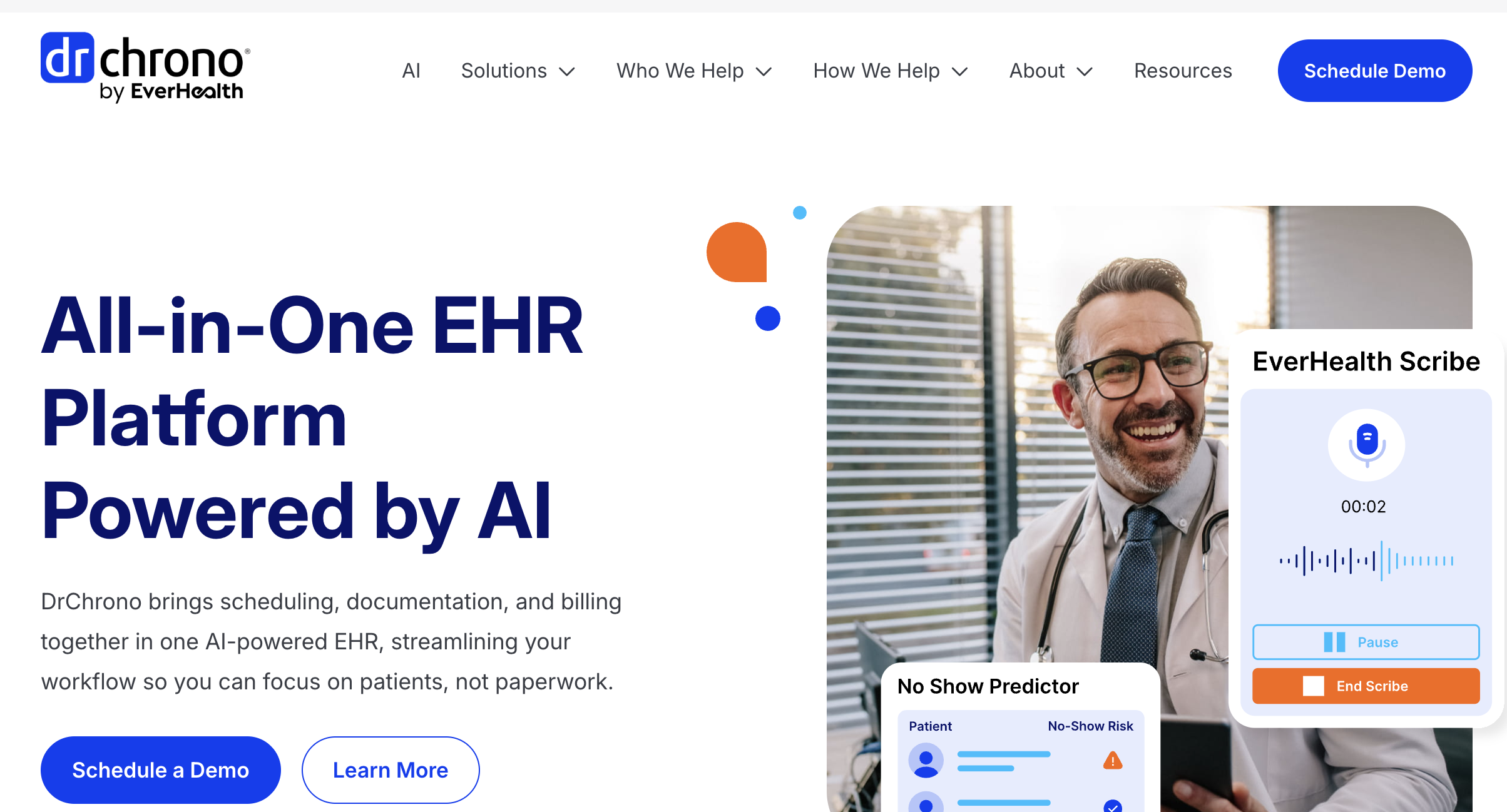
DrChrono is a cloud-based EHR platform with built-in medical billing and coding features, designed specifically for small independent practices. It's not a dedicated CAC platform, but its integrated coding suggestions and billing workflow make it a practical option for practices that want to consolidate tools.
Key features
- Built-in ICD-10 and CPT code search with auto-complete
- Integrated billing and claim submission
- Appointment scheduling and EHR in one platform
- Mobile-friendly
Best for
DrChrono users in small practices (1–5 clinicians) who want an integrated EHR/billing solution rather than a standalone coding tool.
Pricing
Tiered subscription plans starting around $199/month per provider.
6. Greenway Health (Best for practices on the Greenway EHR)
Overview
Greenway Health offers coding assistance built directly into the Greenway Prime Suite and Intergy EHR platforms. For practices already in the Greenway ecosystem, the integration is seamless — code suggestions appear within the existing charting workflow.
Key features
- EHR-native code suggestions
- E&M leveling assistance
- Compliance checking
- Denial management workflow
Best for
Practices already using a Greenway EHR who want to reduce context-switching.
Pricing
Included or add-on within Greenway subscription plans. Contact for pricing.
Is AI medical coding HIPAA compliant?
Yes — when the software is purpose-built for healthcare. The critical distinction is between consumer AI tools (like ChatGPT) and HIPAA-compliant platforms built for clinical environments.
Using a consumer AI chatbot to generate or suggest medical codes is not HIPAA-compliant. These tools don't sign Business Associate Agreements, don't have healthcare-grade data security controls, and may use your inputs to train their models — meaning PHI could be exposed.
HIPAA-compliant AI coding tools, by contrast, are built with healthcare requirements at the core:
How Freed handles PHI and compliance
- Signs a Business Associate Agreement (BAA) with every customer
- PHI is encrypted at rest using AES-256 and in transit using TLS 1.2–1.3
- All data stored within the United States (Microsoft Azure infrastructure)
- Patient recordings are automatically deleted once the note is complete
- AI is trained exclusively on de-identified data — never on PHI
- SOC 2 Type 1 and Type 2 certified, with regular third-party audits
- Meets HIPAA, HITECH, and OWASP standards
- Cryptographic modules follow FIPS PUB 140-2 standards
Essentially, the tool matters. A BAA and SOC 2 certification signal that the vendor has built security into their architecture, rather than bolting it on afterward.
Medical coding software pricing guide
Medical coding software pricing varies significantly based on the type of tool, the size of the organization, and the pricing model.
Subscription pricing (per clinician/month): Most common for independent and mid-size practices. Ranges from approximately $39–$199/month per clinician for AI-assisted or integrated tools, with volume discounts for larger groups.
Enterprise licensing (custom)
Standard for 3M, Optum, and similar platforms. Typically involves multi-year contracts and implementation fees. These solutions are generally cost-effective only when claim volume is very high.
Per-claim pricing
Some billing-company-oriented platforms charge per claim processed. This can be cost-effective at low volume but becomes expensive for high-volume practices.
Pricing tiers
A handful of tools — including Freed's Chrome extension for EHR integration — offer tiered entry points with paid upgrades for advanced features. Many include free trials.
For practices evaluating ROI, the math is relatively straightforward: if improved coding accuracy reduces denial rates by even 1–2%, and a practice processes 100 claims per day at an average reimbursement of $150, that's a meaningful annual recovery.
Freed's internal modeling suggests clinicians who use Freed save 1.5+ hours per day in documentation time — capacity that can translate to additional patient encounters or earlier end-of-day.
Choosing a medical coding solution
Medical coding software has matured significantly. The best tools today don't just look up codes; they read clinical documentation intelligently, suggest accurate codes in context, and integrate with the EHR workflows your team already uses.
For practices using Freed for AI documentation, Freed's Coding Assistant is the logical next step: codes flow from the note you already generated, without duplicate work or a separate login. For larger organizations with complex inpatient coding needs, enterprise platforms from 3M or Optum offer the depth and compliance infrastructure those environments require.
The most important thing is to match the tool to your actual workflow — not to pay for complexity you don't need.
Spend less time on codes, more time on patients. Try Freed Coding free →

6 Best Medical Coding Software of 2026: Ranked for Accuracy, Speed & Compliance

Table of Contents
Medical coding errors are expensive. Industry data consistently shows claim denial rates of 5–10%, and even a modest improvement in coding accuracy can recover thousands of dollars annually for a busy practice.
Whether you're a billing manager comparing platforms or a practice owner trying to tighten revenue cycle management, the right medical coding software is one of the highest-leverage investments you can make.
This guide breaks down the best medical coding software available in 2026, with a clear-eyed look at:
- Accuracy
- EHR integration
- HIPAA compliance
- Pricing
So you can make a confident decision without wading through vendor marketing.
What is medical coding software?
Medical coding software converts clinical documentation lik physician notes, encounter records, and procedure descriptions into standardized codes used for billing and reimbursement.
These include ICD-10 codes (diagnoses), CPT codes (procedures), and HCPCS codes (supplies and services billed to Medicare and Medicaid).
Accurate coding determines how quickly and how much a practice gets paid. Undercoding leaves revenue on the table. Overcoding invites audits. The goal is precision: codes that accurately reflect the care provided.
Rule-based vs. AI-native coding engines
Traditional medical coding software uses rule-based logic — essentially lookup tables and keyword matching — to suggest codes based on terms found in documentation. These tools are structured, predictable, and familiar to many billing departments, but they require clean, standardized input and can miss nuanced clinical language.
AI-native coding engines read clinical documentation the way a trained coder would. They interpret context, recognize clinical concepts regardless of how they're phrased, and learn from corrections over time. This makes them faster and more accurate for real-world notes, which are rarely perfectly structured.
How to choose medical coding software
AI-powered vs. rule-based coding
The right choice depends on your documentation environment.
If your practice generates structured, templated notes, rule-based systems can work adequately. If your clinicians dictate freeform notes — or use an AI scribe — an AI-native coding engine will perform significantly better, since it reads clinical language rather than searching for keywords.
ICD-10 and CPT code accuracy rates
Ask vendors for validated accuracy data, not just marketing claims. Specifically: what is the first-pass acceptance rate on code suggestions? What is the post-review denial rate? The best tools provide transparent benchmarking across specialties.
Look for vendors that can demonstrate:
- Coding validation workflows
- Audit capabilities
- Quality assurance processes
- Human review mechanisms
EHR integration and workflow fit
Code suggestions that require copy-pasting from one system to another slow coders down and introduce errors. Look for software that integrates directly with your existing EHR, pushes codes into the right fields, and fits naturally into the workflow your team already uses.
The fewer systems staff must switch between, the greater the efficiency gains.
HIPAA compliance and audit trail
Every tool handling protected health information (PHI) must be HIPAA-compliant and willing to sign a Business Associate Agreement (BAA). Beyond the BAA, look for SOC 2 Type 2 certification, end-to-end encryption, and clear data retention policies. The audit trail matters too — you need to be able to show, if reviewed, exactly what was coded and when. Compliance requirements become even more important when AI is involved.
Pricing model (per-claim vs. subscription)
Medical coding software pricing typically falls into one of three categories:
- Subscription pricing
- Per-user licensing
- Per-claim pricing
Per-claim pricing is intuitive but can become expensive as volume grows. Subscription pricing is more predictable for high-volume practices and billing companies. Evaluate all models against your actual claim volume.
Best medical coding software of 2026
1. Freed Coding Assistant (Best AI-native coding for independent practices)
Overview
Freed is best known as an AI medical scribe. It listens to patient encounters and generates clinical notes automatically, eliminating hours of documentation burden. Freed's Coding Assistant extends this intelligence: after a note is generated, Freed reads the documentation and suggests appropriate ICD-10 and CPT codes inline, without requiring any separate workflow.
For practices already using Freed for documentation, coding becomes a natural extension rather than a separate process. There's no copy-paste, no context-switching, and no need to re-read the note in a different system. The AI has already captured and understood the encounter; code suggestions follow directly from that.
Key features
- Post-visit coding suggestions
- Automatic, accurate, ICD-10 and CPT codes at the highest justified E/M level
- Analysis of clinic-wide billing trends to improve coding choices in future visits
- Coding impact dashboard
- AI chat functionality for increased code recommendations
- Works with existing EHR through Chrome extension or direct integration
Best for
Independent practices, small-to-mid-size groups (2–50 clinicians), and billing companies managing multiple client practices who want AI coding as part of a broader documentation workflow.
Pricing
Freed's Premier plan is 104/month. Group and enterprise pricing available with volume discounts.
See Freed's Coding Assistant in action — watch how it auto-suggests codes from your documentation. Book a demo →
2. Solventum 360 Encompass (Best for large hospital systems)
Overview
3M 360 Encompass is one of the most established computer-assisted coding (CAC) platforms in the market, built primarily for inpatient coding in large health systems. It uses natural language processing to read clinical documentation and suggest ICD-10-CM/PCS codes for inpatient encounters.
Key features
- Deep NLP engine trained on large inpatient datasets
- Tight integration with Epic and other enterprise EHRs
- Robust audit and compliance reporting
- Physician query workflow built in
Best for
Large hospitals and health systems with dedicated inpatient coding departments.
Pricing
Enterprise licensing; custom quotes. Generally priced for organizations with high inpatient volume.
Notable limitation
Overkill and cost-prohibitive for independent or outpatient-focused practices. Implementation requires IT resources.
3. Optum360 (Best for revenue cycle management firms)
Overview
Optum360 offers a suite of coding tools including computer-assisted coding, CDI (clinical documentation improvement), and denial management. It's oriented toward revenue cycle companies and large health systems managing complex billing operations.
Key features
- AI-assisted ICD-10 and CPT coding
- CDI workflow integration
- Denial analytics
- Compliance dashboards
Best for
Revenue cycle management organizations and large integrated health networks.
Pricing
Custom enterprise pricing; not designed for individual practices.
4. Dolbey Fusion CAC (Best for outpatient and multi-specialty coding)
Overview
Dolbey Fusion CAC is a computer-assisted coding platform covering both inpatient and outpatient coding workflows, with configurable rules and NLP-driven suggestions. It's a strong option for multi-specialty practices that need flexibility across service lines.
Key features
Configurable coding engines for different specialties; supports ICD-10, CPT, and E&M leveling; integration with major EHRs; audit trail and compliance reporting.
Best for
Multi-specialty practices and ambulatory surgery centers.
Pricing
Subscription-based; pricing scales with volume and number of users. Contact for quote.
5. DrChrono (Practices already locked into the DrChrono EHR ecosystem who need basic coding assistance built in)
Overview
DrChrono is a cloud-based EHR platform with built-in medical billing and coding features, designed specifically for small independent practices. It's not a dedicated CAC platform, but its integrated coding suggestions and billing workflow make it a practical option for practices that want to consolidate tools.
Key features
- Built-in ICD-10 and CPT code search with auto-complete
- Integrated billing and claim submission
- Appointment scheduling and EHR in one platform
- Mobile-friendly
Best for
DrChrono users in small practices (1–5 clinicians) who want an integrated EHR/billing solution rather than a standalone coding tool.
Pricing
Tiered subscription plans starting around $199/month per provider.
6. Greenway Health (Best for practices on the Greenway EHR)
Overview
Greenway Health offers coding assistance built directly into the Greenway Prime Suite and Intergy EHR platforms. For practices already in the Greenway ecosystem, the integration is seamless — code suggestions appear within the existing charting workflow.
Key features
- EHR-native code suggestions
- E&M leveling assistance
- Compliance checking
- Denial management workflow
Best for
Practices already using a Greenway EHR who want to reduce context-switching.
Pricing
Included or add-on within Greenway subscription plans. Contact for pricing.
Is AI medical coding HIPAA compliant?
Yes — when the software is purpose-built for healthcare. The critical distinction is between consumer AI tools (like ChatGPT) and HIPAA-compliant platforms built for clinical environments.
Using a consumer AI chatbot to generate or suggest medical codes is not HIPAA-compliant. These tools don't sign Business Associate Agreements, don't have healthcare-grade data security controls, and may use your inputs to train their models — meaning PHI could be exposed.
HIPAA-compliant AI coding tools, by contrast, are built with healthcare requirements at the core:
How Freed handles PHI and compliance
- Signs a Business Associate Agreement (BAA) with every customer
- PHI is encrypted at rest using AES-256 and in transit using TLS 1.2–1.3
- All data stored within the United States (Microsoft Azure infrastructure)
- Patient recordings are automatically deleted once the note is complete
- AI is trained exclusively on de-identified data — never on PHI
- SOC 2 Type 1 and Type 2 certified, with regular third-party audits
- Meets HIPAA, HITECH, and OWASP standards
- Cryptographic modules follow FIPS PUB 140-2 standards
Essentially, the tool matters. A BAA and SOC 2 certification signal that the vendor has built security into their architecture, rather than bolting it on afterward.
Medical coding software pricing guide
Medical coding software pricing varies significantly based on the type of tool, the size of the organization, and the pricing model.
Subscription pricing (per clinician/month): Most common for independent and mid-size practices. Ranges from approximately $39–$199/month per clinician for AI-assisted or integrated tools, with volume discounts for larger groups.
Enterprise licensing (custom)
Standard for 3M, Optum, and similar platforms. Typically involves multi-year contracts and implementation fees. These solutions are generally cost-effective only when claim volume is very high.
Per-claim pricing
Some billing-company-oriented platforms charge per claim processed. This can be cost-effective at low volume but becomes expensive for high-volume practices.
Pricing tiers
A handful of tools — including Freed's Chrome extension for EHR integration — offer tiered entry points with paid upgrades for advanced features. Many include free trials.
For practices evaluating ROI, the math is relatively straightforward: if improved coding accuracy reduces denial rates by even 1–2%, and a practice processes 100 claims per day at an average reimbursement of $150, that's a meaningful annual recovery.
Freed's internal modeling suggests clinicians who use Freed save 1.5+ hours per day in documentation time — capacity that can translate to additional patient encounters or earlier end-of-day.
Choosing a medical coding solution
Medical coding software has matured significantly. The best tools today don't just look up codes; they read clinical documentation intelligently, suggest accurate codes in context, and integrate with the EHR workflows your team already uses.
For practices using Freed for AI documentation, Freed's Coding Assistant is the logical next step: codes flow from the note you already generated, without duplicate work or a separate login. For larger organizations with complex inpatient coding needs, enterprise platforms from 3M or Optum offer the depth and compliance infrastructure those environments require.
The most important thing is to match the tool to your actual workflow — not to pay for complexity you don't need.
Spend less time on codes, more time on patients. Try Freed Coding free →
FAQs
Frequently asked questions from clinicians and medical practitioners.

What is the best software for medical coding?

Can AI replace medical coders?
How accurate is AI medical coding?
Does medical coding software integrate with EHRs?
What is medical coding
How does Freed support medical coding?
How does medical coding impact billing?
Related content
Free yourself for better things


548 Market Street, PMB 95301
San Francisco, CA 94104
Specialties
Compliance & Security
Our technology is HIPAA-compliant, uses industry best practices, and doesn’t store patient recordings.