The Real ROI of AI Scribes for Small Clinics
You almost can’t say “clinical documentation” without saying “burnout.”
Small and midsized clinics are no strangers to this burden. With limited staffing and rising admin load, every hour spent on charts is an hour taken from patients, revenue, or rest.
That’s where AI scribes come in. But are they really worth it?
For clinic owners and administrators, evaluating ROI comes first. You need to know whether the investment results in measurable time savings, cleaner notes, and fewer operational bottlenecks.
Freed’s data shows that when an AI scribe is built specifically for clinicians — not large enterprise systems — the return becomes clear within weeks.
Below, we break down the core value drivers small clinics see when introducing an AI scribe, and what makes Freed an especially strong fit.
The benefits of AI scribes in small clinics
Small clinics especially see strong ROI through:
- Time savings
- High-quality notes
- Faster billing
- Less burnout
In this article, we break down how these benefits play out in real life, and how that translates to a stronger practice overall.
1. Time saved that converts directly into capacity and relief
Clinicians lose an average of 86 minutes every day to “pajama time” documentation after hours. That administrative load is even heavier for small teams, where there’s no buffer and no room to fall behind.
With Freed, clinicians report saving 5–15 hours per week, and nearly 20% save 15+ hours weekly. For most practices, that reclaimed time translates into:
- Finishing notes faster
- Reducing evening work
- The option to see more patients
- A noticeable drop in mental load
These outcomes aren’t abstract — they’re direct reports from clinics already using Freed.

2. Faster note completion that improves billing timelines
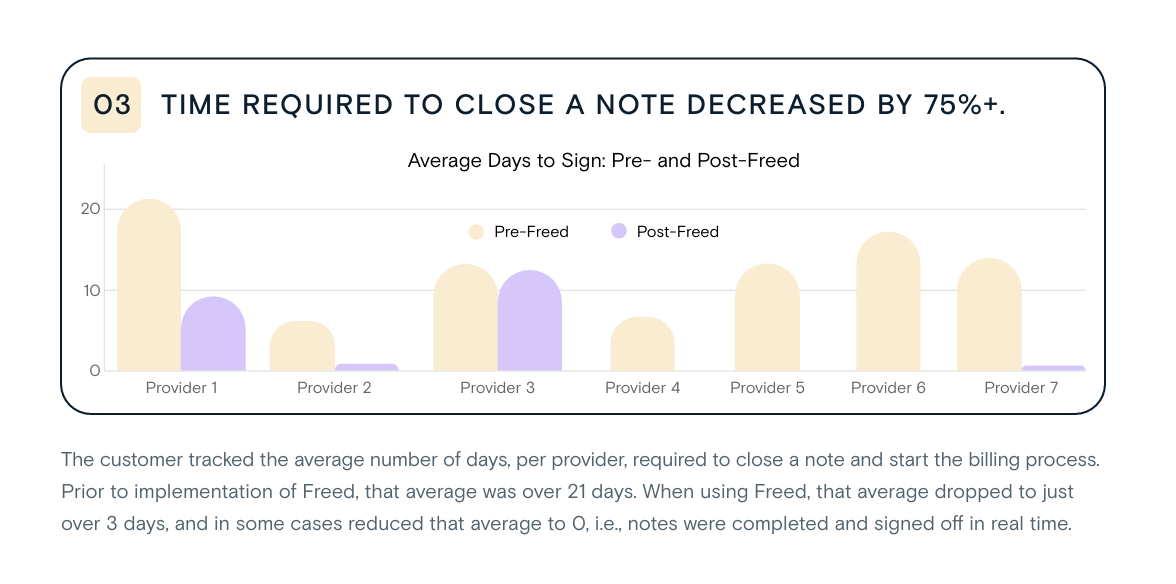
Delayed notes slow down billing. In one case study, a multi-specialty health system in the US Midwest reported that notes typically sat open for 21 days before being signed and billed.
After adopting Freed, that window dropped to 3 days or less — and in many cases, notes were completed that same day.
For small practices operating month to month, faster billing cycles can improve:
- Cash flow stability
- Predictability of revenue
- Fewer end-of-month logjams
These improvements support healthier operations without adding staff or new systems.
3. Accurate, structured documentation that supports clean claims
Better notes don’t just save time — they reduce rework. Small clinics often navigate coding and documentation with limited administrative support. The cognitive load pushes clinicians to the brink — and any inaccuracies can become fiscally and mentally costly.
Freed’s notes are:
- Accurate — Background noise is removed, and each note goes through a final AI review to ensure consistency and accuracy
- Structured — Notes are in the SOAP format, and they adapt to the clinician’s edits.
- Clinically relevant — Our AI models are specifically trained in clinical contexts, including over 27,000 medications and medical terms. It also offers ICD-10 code suggestions to streamline coding.
- Aligned to specialty workflows — Notes themselves are filtered by the user’s specialty, and our library of customizable templates matches each clinician’s preferences.
This supports cleaner, complete documentation that helps downstream processes run more smoothly.
4. Lower burnout and higher retention — a major cost saver
Replacing a clinician can cost $115,500 when considering recruitment and lost productivity . Avoiding even a single departure makes a meaningful financial difference for a small clinic.
In a survey conducted of customers using Freed:
- 100% reported improved work-life balance
- 80% felt overall happier during their day
- 80% saw improvements in patient care quality

Reducing documentation burden isn’t simply an operational win — it’s directly tied to clinician well-being, which protects continuity of care and clinic stability.
5. A simple, low-lift setup that accelerates time to value
Implementation effort plays a major role in the ROI of any AI scribe. Tools that are easy to adopt and fit smoothly into existing EHR workflows help clinics see value faster. With tools like Freed, clinicians are typically recording their first visit within minutes.
The Chrome Extension makes this especially easy, offering instant installation and universal compatibility with any browser-based EHR, plus simple copy-and-paste workflows that minimize tab switching.
For clinics using supported systems, Freed’s EHR push functionality (currently in beta) takes that efficiency further by sending notes directly into the right EHR fields.
This matters because small clinics see faster ROI when the tool starts helping on day one.
6. Pricing designed specifically for small and midsized clinics
ROI often comes down to balancing value with cost — how can we get a measurable impact without financial strain?
Budget-friendly pricing, predictable monthly costs, and flexibility for 2–10 clinician groups are often key factors in making adoption feasible.
Freed’s small-group tier, for example, is $84 per clinician per month, billed annually, which aligns with the needs of clinics operating with leaner budgets. Traditional human scribes often exceed $375 per month, and AI scribe alternatives range from $208 to $830 monthly based on industry data .
Transparent, right-sized pricing helps smaller practices adopt AI support in a sustainable way and begin capturing the operational and documentation gains that drive ROI.
Putting the numbers together
With Freed’s AI scribe, A consistent pattern emerges across the data:
- 5-15 hours saved weekly
- 21 → 3 day note closure
Higher documentation consistency - Lower burnout risk
- Predictable, accelerated billing
- Support for better coding workflows
These improvements work together to show real value, fast. That’s why small and mid-sized practices across hundreds of specialties are choosing Freed and reporting significant ROI.
But every clinic is different. The best way to understand your own return is to model it with your actual numbers.
CTA: calculate your clinic’s potential ROI
Want a clearer picture of what an AI scribe could mean for your clinic?
Freed’s ROI calculator gives you a personalized estimate of time saved, billing acceleration, and potential financial impact — based on your clinic’s size, visit volume, and staffing.
It takes less than a minute to see how the numbers add up.

Table of Contents
You almost can’t say “clinical documentation” without saying “burnout.”
Small and midsized clinics are no strangers to this burden. With limited staffing and rising admin load, every hour spent on charts is an hour taken from patients, revenue, or rest.
That’s where AI scribes come in. But are they really worth it?
For clinic owners and administrators, evaluating ROI comes first. You need to know whether the investment results in measurable time savings, cleaner notes, and fewer operational bottlenecks.
Freed’s data shows that when an AI scribe is built specifically for clinicians — not large enterprise systems — the return becomes clear within weeks.
Below, we break down the core value drivers small clinics see when introducing an AI scribe, and what makes Freed an especially strong fit.
The benefits of AI scribes in small clinics
Small clinics especially see strong ROI through:
- Time savings
- High-quality notes
- Faster billing
- Less burnout
In this article, we break down how these benefits play out in real life, and how that translates to a stronger practice overall.
1. Time saved that converts directly into capacity and relief
Clinicians lose an average of 86 minutes every day to “pajama time” documentation after hours. That administrative load is even heavier for small teams, where there’s no buffer and no room to fall behind.
With Freed, clinicians report saving 5–15 hours per week, and nearly 20% save 15+ hours weekly. For most practices, that reclaimed time translates into:
- Finishing notes faster
- Reducing evening work
- The option to see more patients
- A noticeable drop in mental load
These outcomes aren’t abstract — they’re direct reports from clinics already using Freed.
2. Faster note completion that improves billing timelines
Delayed notes slow down billing. In one case study, a multi-specialty health system in the US Midwest reported that notes typically sat open for 21 days before being signed and billed.
After adopting Freed, that window dropped to 3 days or less — and in many cases, notes were completed that same day.
For small practices operating month to month, faster billing cycles can improve:
- Cash flow stability
- Predictability of revenue
- Fewer end-of-month logjams
These improvements support healthier operations without adding staff or new systems.
3. Accurate, structured documentation that supports clean claims
Better notes don’t just save time — they reduce rework. Small clinics often navigate coding and documentation with limited administrative support. The cognitive load pushes clinicians to the brink — and any inaccuracies can become fiscally and mentally costly.
Freed’s notes are:
- Accurate — Background noise is removed, and each note goes through a final AI review to ensure consistency and accuracy
- Structured — Notes are in the SOAP format, and they adapt to the clinician’s edits.
- Clinically relevant — Our AI models are specifically trained in clinical contexts, including over 27,000 medications and medical terms. It also offers ICD-10 code suggestions to streamline coding.
- Aligned to specialty workflows — Notes themselves are filtered by the user’s specialty, and our library of customizable templates matches each clinician’s preferences.
This supports cleaner, complete documentation that helps downstream processes run more smoothly.
4. Lower burnout and higher retention — a major cost saver
Replacing a clinician can cost $115,500 when considering recruitment and lost productivity . Avoiding even a single departure makes a meaningful financial difference for a small clinic.
In a survey conducted of customers using Freed:
- 100% reported improved work-life balance
- 80% felt overall happier during their day
- 80% saw improvements in patient care quality
Reducing documentation burden isn’t simply an operational win — it’s directly tied to clinician well-being, which protects continuity of care and clinic stability.
5. A simple, low-lift setup that accelerates time to value
Implementation effort plays a major role in the ROI of any AI scribe. Tools that are easy to adopt and fit smoothly into existing EHR workflows help clinics see value faster. With tools like Freed, clinicians are typically recording their first visit within minutes.
The Chrome Extension makes this especially easy, offering instant installation and universal compatibility with any browser-based EHR, plus simple copy-and-paste workflows that minimize tab switching.
For clinics using supported systems, Freed’s EHR push functionality (currently in beta) takes that efficiency further by sending notes directly into the right EHR fields.
This matters because small clinics see faster ROI when the tool starts helping on day one.
6. Pricing designed specifically for small and midsized clinics
ROI often comes down to balancing value with cost — how can we get a measurable impact without financial strain?
Budget-friendly pricing, predictable monthly costs, and flexibility for 2–10 clinician groups are often key factors in making adoption feasible.
Freed’s small-group tier, for example, is $84 per clinician per month, billed annually, which aligns with the needs of clinics operating with leaner budgets. Traditional human scribes often exceed $375 per month, and AI scribe alternatives range from $208 to $830 monthly based on industry data .
Transparent, right-sized pricing helps smaller practices adopt AI support in a sustainable way and begin capturing the operational and documentation gains that drive ROI.
Putting the numbers together
With Freed’s AI scribe, A consistent pattern emerges across the data:
- 5-15 hours saved weekly
- 21 → 3 day note closure
Higher documentation consistency - Lower burnout risk
- Predictable, accelerated billing
- Support for better coding workflows
These improvements work together to show real value, fast. That’s why small and mid-sized practices across hundreds of specialties are choosing Freed and reporting significant ROI.
But every clinic is different. The best way to understand your own return is to model it with your actual numbers.
CTA: calculate your clinic’s potential ROI
Want a clearer picture of what an AI scribe could mean for your clinic?
Freed’s ROI calculator gives you a personalized estimate of time saved, billing acceleration, and potential financial impact — based on your clinic’s size, visit volume, and staffing.
It takes less than a minute to see how the numbers add up.
FAQs
Frequently asked questions from clinicians and medical practitioners.

Are AI scribes worth it?

Will an AI scribe integrate with my EHR?
Are AI scribes accurate enough for SOAP notes?
Can AI scribes replace manual note-taking completely?
Can Freed accurately transcribe visits conducted through interpreters or in other languages?
Are AI scribes HIPAA compliant?
Does Freed integrate with EHRs and EMRs?

Related content
Free yourself for better things


548 Market Street, PMB 95301
San Francisco, CA 94104
Specialties
Compliance & Security
Our technology is HIPAA-compliant, uses industry best practices, and doesn’t store patient recordings.